 | | | | | | | ||||||||||||||||||
| | |||||||||||||||||||||||
Tony Blair - the end of an era. | ||||||||||||||||||||||||
No more guessing. The British Prime Minister Tony Blair will step down in seven weeks' time. To announce his decision Mr Blair went back to his political birthplace and a meeting of loyal supporters in his constituency of Sedgefield, in north east England.
Ten years after the landslide victory that brought him to power. Mr Blair said a decade was long enough for him and also perhaps for the country. People from around the UK had mixed reactions. It seems that for much of the Biritsh population Mr Blair's international legacy overshadows his actions at home. But how did Tony Blair come to cut such a figure on the world stage in the first place? Why did a labour prime minister whose priorities back in 1997 were famously education education and more education, turn into someone for whom foreign policy, and foreign wars in particular, would become so important? The BBC's foreign affairs specialist, Allan Little, has been examining why Tony Blair went to war quite so often during his decade in power. But what do international politicians think of his ten year performance on the world stage? Here are the thoughts of leaders from the US, the EU, the middle east, Iraq and Afghanistan.
In Africa he won many friends. Mr Blair called poverty, disease, conflict and trade injustice in African countries a 'scar on the world's conscience' and sent British troops into the West African country of Sierra Leone in 2000 to help defeat rebel forces. President John Kufour of Ghana is chairman of the African Union and as he told The World Today, he's a fan of Mr Blair.
Among the leaders who have been reflecting on Tony Blair, Ahmed Tejjan Kaba, the persident og Sierra Leone, has more cause than most to be grateful. In 2000 Mr Blair deployed British troops to that country. They brought an end to 10 years of civil war and stabilised the country's political institutions. Some consider it was this success that first gave Tony Blair a taste for foreign interventions.
And it was Africa that became one of Tony Blair's biggest concerns during his premiership. Two years ago when Britain held the rotating presidency of the Group of 8 industrialised nations, as well as the presidency of the European Union, Mr Blair made sure that the reduction of poverty in Africa was top of the international agenda. But what did he actually achieve? Our Southern Africa correspondent, Peter Biles, reports.
Obviously Tony Blair's departure affects relations with other world leaders and the people he governed for a decade, but for the cartoonists and impressionists of the world, it will mean a dramataic change in their ability to earn a living. The World Today called British satirist Rory Bremner to find out what he made of the momentous news: First broadcast 11th May 2007 | ||||||||||||||||||||||||
| ||||||||||||||||||||||||
| ||||||||||||||||||||||||






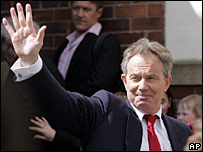
 Tony Blair announces his resignation.
 I've come back here to Sedgefield where my political journey began and where it's fitting it should end. Today I announce my decision to stand down from the leadership of the Labour party. The party will now select a new leader.
 Global News Podcast