 | | | | | | 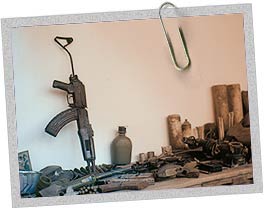 | | | Excess weapons can be collected & re-sold. | |
| | |  | | | Conflicts dragged on for decades. Often the weapons supplied - typically Kalashnikov or M16 assault rifles - were not powerful enough to give either side the edge in the conflict. They were good for controlling territory, but incapable of inflicting defeat.
Despite virtually no domestic small arms production capability themselves, countries like El Salvador, Angola and Cambodia remain among the most heavily militarised societies in the world.
The Cold War may be over, but the million of arms issued by the superpowers and their allies still function. One of the characteristics of assault weapons is their robustness.
The AK-47 rifle, for example, was deliberately designed for use by a poorly trained peasant army in bad weather conditions. It can stand extraordinary punishment. It is said that you can bury an AK-47, or Kalashnikov rifle, in mud, dig it up and have it working again with only minimal cleaning.
The toughness of such rifle designs means that guns issued in Africa or Central America decades ago are still operational today. That in turn means that where peace has been achieved, excess weapons can be gathered up by enterprising criminals and sold on to regions where demand for weapons is higher.
A gun used to fight by a rebel group one year can turn up in the hands of another group the next. A shortage of Kalashnikov rifles is unlikely any time soon, as around 100 million have been produced in the last 50 years. | | < previous |  | |
|




 ^^ Back to top


