The BBC is not responsible for the content of external internet sites
Early on in the war the RUF were indeed reliant on captured rifles and ammunition - there are even reports from 1991 of guerrillas using bows and arrows. But as fighting continued through the mid 1990s, guerrilla leaders expanded their means of acquiring weapons.
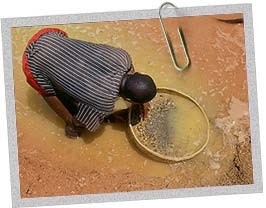
Rebel-mined diamonds were used to buy guns from Liberian sources, and guns from Guinea were traded for consignments of cocoa and coffee. Weapons were even deliberately 'liberated' from peacekeeping soldiers. Aware of the need for arms and munitions, the RUF appear to have expended significant energy in making sure they were well supplied.
Strategically they were right to do so - according to one former RUF soldier who witnessed a diamonds-for-weapons deal on the Liberian border, without such exchanges the RUF might have run out of war arms and ammunition as early as 1997. As it was they fought on until late 2001.
The RUF's continuing re-supply during the 1990s all took place despite the imposition of United Nations embargoes on both Sierra Leone and Liberia.
Among the shipments seem to have been large quantities of weapons and ammunition from Eastern Europe. In one case, in March 1999, 68 tons of Ukrainian weapons was flown to Ouagadougou, capital of Burkina Faso on a British owned Antonov plane.
Most of those arms were then transported to Liberia on another plane, this time originating in Ibiza. Those same weapons were then transported in smaller quantities across the Sierra Leone border.
Without such weapons from abroad the RUF would not have been able to fight so hard or so long. The availability of those guns resulted in the transformation of one of Africa's most resource-rich nations, into a country with the lowest life expectancy in the world.





 ^^ Back to top