| |
| PROGRAMMES FINDER | | |
|
|
|
|
|
|
|
|  | |
|
The Politics of Water 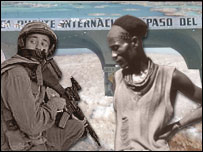 | | Water: a most precious resource |
Water is a basic need and a global right. It's also plentiful. Yet one in five people in the world are without access to safe drinking water.
So why can't the world provide enough clean water for everyone? The answer is usually political.
In this four part series, BBC news journalist Mike Embley investigates some of today's biggest water issues. From the US/Mexico border, to Namibia, Russia, and Israel, Embley builds up a fascinating picture of some of the dividing issues and common themes surrounding this vital liquid.
He talks to the people and communities whose lives are directly affected by water, or the lack of it, and hears compelling testimonies of how political situations are having knock-on affects to real people.
Embley also questions the politicians, industrialists, environmental campaigners and aid workers who are managing these difficult political situations.
US/Mexico border: El Paso/Juarez
Embley visits the world's largest bi-national city El Paso/Juarez, a massive urban area with a border running through it: El Paso on the Texan Side, Juarez on the Mexican side.
Mexico and the US share the same water basin. They have an agreement to provide each other with water, but Mexico has failed to fulfil the agreement and owes the US a massive water debt.
In the context of this political situation, Embley journeys to the border cities of El Paso/Juarez - an area which is suffering its biggest drought for 50 years. The region is also experiencing massive population growth, as people head north from other parts of Mexico to find work.
He talks to the farmers on both sides of the border who are facing the choice of seriously curtailing their crops this year, or even selling off their water instead of farming.
He also finds Mexican immigrant settlers in the US who live in areas with no water, sewage and other basic services, who are adding to the demands on water in the area.
Speaking to politicians in El Paso/Juarez, he asks how the city will deal with their impending water crisis? How will this affect relations? And will Mexico will ever pay off its water debt?
Israel
Embley finds out how Israel's political problems are reflected in the country's use of water.
The Palestinians, have expressed serious complaints against Israel concerning the pumping, use and distribution of water . The issues of water is inseparable from the issues of territory, making it a focal point of the conflict between the two peoples and between Israel and the Arab States.
It relates directly to quality of life, standard of living, and economic development, especially in this semi-arid region, where agriculture plays an important role in the economy.
Embley talks to Palestinians in the village of Beit Furik where families blame the Israeli's for the lack of access to water when their natural wells dry up in summer. The results include lack of water for basic needs like washing and illness as a result of insufficient water.
Talking to Israeli politicians, army spokesmen as well as Oxfam who are working in the area to solve the problem, Embley gets the Israeli response, sees how the issue is being brought to the top of the agenda and discusses what possible solutions can be offered to ease the situation.
Sweden/Russia/Baltic Sea
In the third programme of The Politics of Water, Embley travels to Sweden and Russia to investigate the crisis facing the Baltic Sea.
The Swedish government recently received a damning report on the Sea's serious problems involving pollution, shipping and toxic substances.
Embley investigates the impact on people living around the Baltic. Swedish fishermen face the threat of their industry collapsing. While pregnant women in Sweden are still recommended to eat only small amounts of Baltic herring.
He also travels to St. Petersburg, the largest single source of pollution in the region, to look at how the city is trying to reduce the large quantities of untreated waste water going into the Sea.
Here he poses the question: is there the political will, the money and the time to save the Baltic Sea from ecological disaster?
Nambia
In the final part of The Politics of Water, Embley meets the Himba a semi-nomadic tribe who live in the North-West part of Namibia, on the border with Angola.
They have permanent settlements around the Kunene River where the women, children and older men of the village stay. The younger men travel with the tribe's cattle to find grazing.
This primitive way of life is being threatened by a government plan to build a massive hydropower dam on the Kunene River, which would flood some of the living area and ancient burial grounds of the tribe.
The government are keen to make the country self sufficient in power and sell the excess power to boost the Namibian economy.
The government argue that the dam would bring new tourist opportunities as well as better housing, transport, schools and clinics for the Himba. The Himba argue that they don't need these things, being content to live in the way their forefathers lived.
The Politics of Water, was broadcast on BBC World Service during June, 2003. The series was produced by Unique production company for BBC World Service.
| |
|