
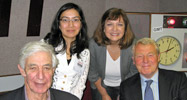
The Forum, the BBC World Service programme which boldly crosses boundaries: scientific, creative and geographic, presented by Bridget Kendall.
MEET THE GUESTS
Bangladeshi writer and anthropologist Tahmima Anam has lived on three continents and her peripatetic lifestyle fuels her belief that as more and more of us come to experience the psychological impact of migration we will develop a greater understanding of what she calls 'otherisation'.
Lewis Wolpert, Emeritus Professor in Cell and Developmental Biology at UCL, is one of the most influential developmental biologists in the world. It's forty years since he first proposed the concept of 'positional information' as a general explanation of how cells 'know' where to grow; he discusses that and his latest thinking on the evolution of development itself - could cellular cannibalism have been the origin of life itself?
British politician and author Paddy Ashdown will be sharing his thoughts on why global interconnectivity demands new thinking about forms of governance; nations must find new ways of listening and talking to each other if we are to survive the challenges of the 21st century
Listen Listen 60 Second Idea to Change the World
Each week one guest presents an idea to enhance the world. 10% of our landmass is at risk from predicted increases in global sea levels, something those with the biggest carbon footprints often find easy to ignore; to raise their awareness Tahmima Anam suggests that for one week and just when they least expect it, they should have salt water piped into their homes.
Your comments...
Lewis Wolpert was talking about clever cells and boring genes. He thought it unlikely that humans would change much in the future. I am not so sure - with climate change revving up it will open great opportunities for rapid evolution. I think we might branch off and develop a race of "Men from Atlantis" or Homo amphibiensis. As the ice caps melt and seas rise, there will be an advantage for humans with extra large feet and hands, preferably with webbing between the digits, as does occur occasionally. These people would be valuable for work in kelp gardens and fish farms or to carry messages speedily between islands. Simply because these specialised humans are gathered together (by reason of their employment) they might well breed with each other and so a new race would develop - alongside the rest of humankind who keep breeding indiscriminately and therefore remain static in evolution.
We will turn around that joke "How long have you believed in evolution?" "Ever since I was a frog."
S.Ashe, Kenya
How cells result in a human who is so much like every other human is a fascinating question. Are there self-organizing systems? How do they work? These are fascinating questions.
Luosquery
I am with Paddy on this. That is how it has to work. Success is not guaranteed, it may get very painful first, but that is how it will come about. And their ARE politicians amongst cells, the ones that have learned...
James
UK
I was particularly interested in the interview with Lewis Wolpert. I wonder whether human beings would behave in similarly co-operative ways towards a harmonious whole (society) if we weren't fed inaccurate and misleading information via education, the media etc. about who we really are. I'm sure that we are infinitely more capable of organising ourselves than we are led to believe. We are hindered in our attempts by those who think they know better - but clearly (see the news) don't.
Sandy
< Back to The Forum
Contact Us
* indicates compulsory fields.
*Edited comments may be published online.

