Wednesday 26 September, 2001
Did Nostradamus predict the present crisis?
The 11th of September attacks on the US that led to the destruction of the World Trade Centre, four commercial aeroplanes and part of the Pentagon, were enough to test anybody's faith.
Since then, Americans have been turning to God, books and the internet in search of answers to why destruction happened. For some, the tragedy had been foretold.
Focus on Faith examines why, for some people, the writings of 16th century mystic Nostradamus provide an explanation to a 21st century tragedy.
Coping with the present

On the surface, the terror acts did not dilute America's belief in God. All across the US there has been a rise in the numbers going to church.
Twelve days after the tragedy, the Yankee Stadium in New York held an interfaith prayer service commemorating the thousands of people killed or missing. Religious leaders of many faiths joined political leaders and entertainers in the offering of prayers.
In an emotional appeal, New York Major Rudolph Giuliani vowed:
| ‘The twin towers may no longer stand, but our skyline will rise again… ’ |
|
Foretelling the future
Americans have been anxious to understand the recent horrific events because of its implications for the future. Mystics have come forward claiming the end of the world may be near.
The most widely read of these so-called prophets is Nostradamus, who has been credited with foretelling the rise of Adolf Hitler, the Challenger space shuttle disaster, the death of both Mother Teresa and Princess Diana.
Within days of the attack on the US, bookshops and wholesalers reported a significant increase in the sales of John Hogue’s 976-page Nostradamus: The Complete Proophecies; Peter Lemesurier’s Nostradamus in the 21st Century, and John Powell’s The Nostradamus Prophecy.
The same editions appeared on the Top Ten bestseller list of the internet bookseller Amazon.com.
According to Anthony Stevens, a professor of religion, insecurity about the future has made Nostradamus required reading for many Americans. He says:
| ‘There is a definite human desire to know something of the future. Especially when people are insecure about that future. So there's always this temptation - let's call it the millennial desire or lust for the apocalyptic that infiltrates all religious experience.’ |
|
'People feel they can pick and choose in terms of their religious belief. We've become quite eclectic. Some have compared it to a buffet, or a cafeteria-style religion, and the appetising tray of Nostradamus for telling the future is the most appealing dessert.’
Email hoax
The sudden rise in sales of Nostradamus’ books has been apparently fuelled by an email message which promoted the idea that the French seer foretold the destruction of the twin towers.
The New York Times newspaper recently noted:
| ‘One email message that was widely circulated… combines… fragments from different passages in Nostradamus' writings with words that were not his, to create a provocative text…’ |
|
The collage states the following:
‘In the year of the new century and nine months / From the sky will come a great King of Terror… The sky will burn at forty-five degrees. Fire approaches the great new city / In the city of York, there will be a great collapse/ 2 twin brothers torn apart by chaos/ while the fortress falls the great leader will succumb / third big war will begin when the big city is burning.’’
Preparing for the future
The increased belief in Nostradamus’ psychic powers, long before the existence of technological innovations such as skyscrapers and aeroplanes, also points to a desire to better understand and to prepare for what an uncertain future of retaliation and prolonged ‘war on terrorism’ might hold.
In the hope of obtaining expert opinion on a threat until recently practically unknown to them, readers in America are also reaching out for books on the Middle East, the World Trade Centre, terrorism and the use of biological weapons.
Opinion poll
Two weeks after the attacks, Amazon.com Top 100 bestseller list continues to mirror the sentiments and concerns of the American people. The UK newspaper The Guardian succinctly called the list, a ‘sort of psychological opinion poll.’
Now, amid fears that terrorists may have planned to use crop-dusting aeroplanes to spray US cities with anthrax, among other biological warfare agents, Nostradamus: The Complete Prophecies has been relegated to number 51 on the bestsellers list.
Occupying number two and three, respectively, are Germs: Biological Weapons and America’s Secret War, by Judith Miller, and Fighting Terrorism: How Democracies Can Defeat Domestic and International Terrorists, by Binyamin Netanyahu.
In Stevens’ words:
‘I do think this sort of desire to find meaning, to find Nostradamus or someone else to tell us what's happening will be with us for a long time to come.’
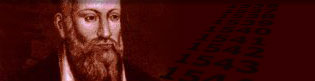
|  |  | | | Nostradamus |  |
| | Michel de Notredame, or Nostradamus, was born in 1503 in France.
He was educated in Latin, Greek, Hebrew, mathematics and astrology. In 1530, he took his baccalaureate at the Medical Faculty at Montpellier.
He was famous for some of his prophecies, among them predicting the death of King Henri II.
He was also known to have effectively helped to fight the spread of a plague outbreak in Aix-en-Provence, in 1546.
He suggested burying corpses between layers of lime; burning rubbish to reduce the food supply for rats; and the constant washing of hands and clothing.
He wrote his prophecies in a mixture of medieval French, Provencale and Latin.
He died in 1566.
|
|  |
| | | | The Prophecy |  |
| | L’an mil neuf cens nonante neuf sept mois. Du ciel viendra un grand Roy d’effrayeur. Resusciter le grand Roy d’Angolmois.
Avant après Mars regner pour bon heur.
In the year 1999 and seven months. From the sky will come a great King of Terror. He will resurrect the King of Angelmois.
Before and Afterwards Mars rules happily.
Nostradamus, 1555. |
| |
|