Friday 14 September, 2001
Afghanistan fears retribution
Since the devastating air strikes on strategic American targets in New York and Washington, there is growing anxiety worldwide that the US will retaliate and launch attacks on Afghanistan.
Three years ago, the US launched cruise missile attacks on training camps in Afghanistan after accusing Saudi dissident Osama Bin Laden of planning the bombing of two American embassies in Africa. Now officials in the US are pointing to Bin Laden as their prime suspect in the recent tragedy.
Outlook talks to Behroz Khan, bureau chief for the Pakistani newspaper The News. Khan describes how people in Afghanistan and Pakistan are reacting to events in the US.
Solidarity

State leaders across the globe have condemned the attack which destroyed the World Trade Centre in New York and seriously damaged the Pentagon in Washington.
The US has even received backing from the North Atlantic Organisation. In an unprecedented show of solidarity, Nato recently declared that the air strikes could be considered to be an attack on the 19-nation alliance.
Some members of Nato however have made it quite clear that they are reluctant to enter war.
US President George W. Bush has described the recent events as an 'act of war' in which, 'make no mistake' the US will win this 'new kind of war.'
He has equally threatened to rally the world to defeat 'people who conducted these acts and those who harbour them.' Once again, Osama Bin Laden, who is believed to be living in Afghanistan under Taleban protection, is suspected of masterminding the attacks.
Crossfire
Pakistan fears it may be caught in the crossfire as it is one of three countries which recognises Taleban-rule in Afghanistan. Soon after the air strikes, Pakistan's military leader Pervez Musharraf quickly assured his country's cooperation with the US in its fight against terrorism.
In a statement Musharraf declared, 'We regard terrorism as an evil that threatens the world community.'
At an impromptu press conference, Mr Bush referred to Mr. Musharraf¡'s statement on cooperation adding, 'now we will find out what that means.'
Perception
Behroz Khan, from the Pakistani newspaper The News, has interviewed Pakistanis about their view on the attack. Khan, whose family originally came from Afghanistan, says:
'They are not happy with what has happened in the US and they do not support these terrorist acts and are worried about the retaliation from the US... they feel America is the victim of its own policies, especially in the middle East.'
| 'There is sympathy with the American people. If they were against the people of America or government of the US, they would have celebrated but no such thing, not in the refugee camps nor any part of the province, people are worried of what will be the consequence of these terrorist attacks.' |
|
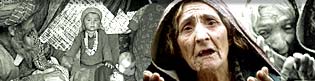
Khan also said people in Kabul, the Afghan capital, live in fear of US retribution. Following the attacks on the US, anti-Taleban forces launched an overnight air and rocket assault against Kabul. People were woken up by massive explosions, believing Western retaliation was already taking place.
'The amount of fear you can judge from the fact that... when there was an attack on Kabul city, people ran for shelter and came out of their houses in the middle of the night, they expected and had heard that it was an attack from the US.
Preventive measures
Fear of a US-led attack on Afghanistan has led the United Nations and numerous other Western aid organisations to take preventive measures and evacuate their foreign staff.
This withdrawal is sure to adversely affect an impoverished country suffering from years of war, famine and severe drought.
Khan believes an overwhelming number of people in Afghanistan will not support Bin Laden or the Taleban if he is involved in the US attacks. Currently there are unconfirmed reports coming from Islamabad, Pakistan, that Bin Laden is being held under house arrest in Afghanistan.
Khan also added people will demand proof from the US government on Bin Laden's involvement in order to evaluate the evidence and consider his extradition. He said:
'People generally believe Osama Bin Laden is not that strong a person to carry out such unprecedented and huge oppression in the US and challenge the mighty power of the world.'
The Taleban government has repeatedly refused to hand over Bin Laden for trial but has said that it would consider extraditing him to the US is his involvement is proven.
|  |  | | | Who is Osama Bin Laden? |  |
| | Osama Bin Laden was born in Saudi Arabia.
He is both a wanted man and a hero of the Islamic world.
A multi-millionaire, he is sought by the US on charges of international terrorism, including the 1998 bombing of American embassies in Africa and the 2001 attack on the USS Cole in Yemen.
He was expelled from Saudi Arabia in 1991 because of his anti-government activities. He then spent the next five years in Sudan, from which he was expelled. After this he returned to Afghanistan.
Attacks linked to Bin Laden include the 1993 World Trade Centre bombing and the killing of 19 US soldiers in Saudi Arabia in 1996. |
|  |
|