
Who should decide the fate of the Amazon rainforest? The people who live there? The Brazilian government? The international community? Or individuals all over the world?
The Amazon Paradox is the struggle between the needs of local people to exploit the rainforest and the global need to preserve its unique nature and resources for the whole world.
On May 15, journalists from the BBC are spending a day in the Amazon: visiting a frontier town where the vast soya fields of Matto Grosso state meet the forest; joining a police operation to stop illegal logging in Para state; and the BBC's Fergus Nicoll is exploring the biggest city in the region - Manaus - in the heart of pristine rainforest.
End of Section
Part one
First stop on the long road into the Amazon: Sao Paulo.
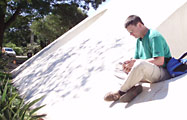
Fergus in Ibirapuera Park
And it really is a world away.
At Ibirapuera Park, it's all metro-chic. European classical music in concert, pampered pooches, designer jogging gear.
It could be Madrid, or New York's Central Park, if it weren't for the rubber-trees and jacarandas growing in thick clumps.
Everywhere around are the strange shaped buildings created by the veteran architect, Oscar Niemeyer.
The German symphony orchestra plays inside a vast white triangle like a giant slab of cheese. Not far away is an immense white dome with porthole windows: an art gallery built in the style of an Amazonian Indian community hall.
Slash and burn
And hang on, here's a bit of a culture clash. Not far from the Beethoven, two "repentista" poets prove that the indigenous oral tradition of Brazil is still vibrantly alive.
They're having a face-off, bashing their tambourines, each attempting to out-improvise his rival.
Slip them a few reals and they'll effortlessly slide into a punchy, rhyming denunciation of the slash and burn tactics employed by the Amazon rainforest raiders so far to the north.
Fast-forward to the federal capital, Brasilia, and Niemeyer is impossible to escape.
In front of the double towers that dominate the National Congress, the deputies enjoy some typical Niemeyer architecture: the Senate is housed in a cup-shaped white edifice, the Assembly in an upside-down version of the same.
Inside, though, there's serious business afoot.
The Commission on Amazonia is hosting a conference on sexual exploitation and the roster of speakers includes top cops, powerful State officials and campaigning bishops.
Litany of complaints
For anyone who cares about the Amazon, though, the big news of the week is the government's new master-plan to save the rainforest.
But it is hard to find optimists.
I hear a litany of complaints about power-struggles between the States and the centre, a lack of inter-ministry cooperation and a reluctance to rein in the cattle-ranchers and soya-farmers making inroads into the Amazon's protected territories.
The new buzz phrases are all about global carbon markets, public-private partnerships and - above all - making the forest worth more standing than it would be chopped down.
And the optimists have two charismatic figureheads to pin their hopes on: the rubber-tapper turned Environment Minister, Marina Silva, and the former trades unionist rabble-rouser, President Lula.
Only if he knocks heads together will real change happen.
End of Section
Part two
It's mid-morning in Manaus and the rain is falling like a grey curtain, obscuring the sweep of the Rio Negro, one of the Amazon's biggest tributaries, that only minutes ago gleamed in the distance.
Manaus is an industrial city in the heart of the rainforest, a gritty concrete island in a sea of green.
It's also the regional equivalent of the main motorway, on which boats of varying sizes carry freight, food and villagers into the more remote reaches of the jungle.
And it's the jungle that simply astonishes the eye - that misty blanket of green stretching off beyond the horizon.
Unlike other states like Matto Grosso and Pará, Amazonas State is still 99% forested.
Into the trees
So that's where I'm heading tonight, out into the trees on patrol with the Brazilian army and their indigenous Indian trackers.
In the meantime, though, there's work to be done here in town, editing material for our big programme day on May 15th.
I've spent three days in the federal capital, Brasilia, talking to the movers and shakers in government, from the NGO movements and powerful outsiders like the World Bank.
But Manaus, as state capital of Amazonas, is the nerve centre for sustainable forestry, indigenous culture and river trade.
Busy days ahead.
End of Section
For a guide to listening to the Amazon Paradox, click
here.

