| | | | | | | ||||||
| | |||||||||||
Learning English - Words in the News 17 September, 2008 - Published 13:51 GMT Argentines head for EU | ||||||||||||
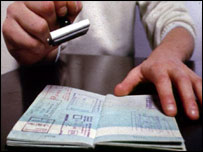
While most Argentines are of Spanish and Italian descent, embassies in Buenos Aires representing countries that recently joined the European Union - e.g. Estonia, Lithuania and Poland - are reporting a big increase in passport applications. Daniel Schweimler reports: The truth is, said Sebastian, an Argentine, it does feel strange being Estonian. He doesn't speak the language, has never been to Tallinn and knows little about the Baltic state's history or customs. But thanks to an Estonian grandfather who emigrated to Argentina in the first half of the twentieth century, he now has an Estonian passport, which gives him access to the European Union. Sebastian is one of a growing number of Argentines discovering their East European roots. The Polish, Slovak, Slovenian, Estonian and Lithuanian embassies in Buenos Aires all report a growing number of enquiries and applications for passports. The Romanians, who demand that applicants speak the language, say many ask where they can learn it. Many Argentine youngsters are simply looking for a quick and easy entrance to the European Union - some to travel, others to work. But Argentina also suffers periodic economic and political crises, and many like to have a second passport in case the need to escape should arise. During the economic collapse of 2001, the queues outside the Italian and Spanish consulates in Buenos Aires stretched for several blocks. But now the Lithuanian authorities say that surnames such as Rodriguez and Sanchez are becoming increasingly common on the streets of Vilnius. Daniel Schweimler, BBC News, Buenos Aires customs emigrated gives him access to discovering roots periodic to escape economic collapse stretched for several blocks becoming increasingly common |
Latest stories 27 May, 2011 Destruction of smallpox virus delayed 25 May, 2011 Micro-finance 'misused and abused' 20 May, 2011 Lonely planets 18 May, 2011 Germany to invest in more electric cars 16 May, 2011 Argentina builds a tower of books Other Stories | |||||||||||
Useful links | ||||||||||||