| | | | | | | ||||||
| | |||||||||||
Learning English - Words in the News 25 August, 2008 - Published 12:00 GMT NASA delays spacecraft launch | ||||||||||||
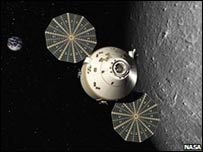
NASA says the Orion spacecraft, designed to replace the space shuttle, won't be launched until 2014 because of technical difficulties and budgetary pressures - meaning a four year gap between the last shuttle mission and the new vehicle's first flight. Matt McGrath reports: With the three remaining space shuttles due to retire in 2010, NASA had hoped to have the Orion replacement craft on the launch pad by 2013. But now, they say, the window of opportunity to accelerate the project has closed, and the first mission is likely to be a trip to the International Space Station in September 2014. NASA had hoped that additional funding from the US congress would have allowed an earlier launch but this has not been authorised. The delay means that the United States will be dependant on the Russian space agency to ferry crews to the ISS for almost four years. Launched on top of a two stage Ares rocket, the Orion space craft is a crucial part of NASA's vision for the future, as it will be part of the programme that includes returning astronauts to the moon by 2020. The Constellation program, as it is called, has come in for strong criticismon the grounds of safety. The Aerospace Safety Advisory Panel said the new vehicle might not be capable of providing adequate protection against hazards that will only come to light once the spacecraft is in operation. NASA, according to the report, was not putting enough emphasis on safety and reliability, and the program was facing difficulties with money, morale and leadership. Matt McGrath, BBC due to retire on the launch pad to accelerate additional funding to ferry crews a crucial part of NASA's vision come in for strong criticism on the grounds of safety come to light putting enough emphasis on |
Latest stories 27 May, 2011 Destruction of smallpox virus delayed 25 May, 2011 Micro-finance 'misused and abused' 20 May, 2011 Lonely planets 18 May, 2011 Germany to invest in more electric cars 16 May, 2011 Argentina builds a tower of books Other Stories | |||||||||||
Useful links | ||||||||||||