| | | | | | | ||||||
| | |||||||||||
Learning English - Words in the News 16 July, 2008 - Published 11:59 GMT China 'could reach Moon by 2020' | ||||||||||||
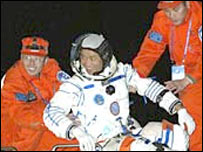
The United States wants to send astronauts back to the Moon by 2020, but China could get there before them. Dr Michael Griffin told the BBC that China is now capable of sending a manned mission to the Moon within the next decade. Here's our science reporter Paul Rincon: China has been working on its space programme since the 1970s but in 2003 it sent an astronaut into space, becoming only the third country to launch a person into orbit. Since then, the country's ambitions and capability have grown to the point where the US space agency now thinks China could put people on the Moon within the next decade, if it so wishes. Dr Michael Griffin, who has been the head of NASA since 2005, told the BBC that China could achieve this milestone before the return mission planned by the United States for the year 2020. President George Bush announced the American Moon initiative in 2004, but Dr Griffin would not be drawn on whether it mattered if China got there before the United States. He even hinted that the two countries could collaborate on space projects in future. Dr. Michael Griffin: Though China has given no timetable, some observers think a manned Moon mission is inevitable. Dr Griffin said humans needed to continue advancing the frontiers of space exploration, regardless of which countries made the breakthroughs. Paul Rincon, BBC science reporter to launch a person into orbit if it so wishes milestone would not be drawn on hinted collaborate on collaborate rather than quarrel timetable inevitable advancing the frontiers of space exploration |
Latest stories 27 May, 2011 Destruction of smallpox virus delayed 25 May, 2011 Micro-finance 'misused and abused' 20 May, 2011 Lonely planets 18 May, 2011 Germany to invest in more electric cars 16 May, 2011 Argentina builds a tower of books Other Stories | |||||||||||
Useful links | ||||||||||||