| | | | | | | ||||||
| | |||||||||||
Learning English - Words in the News 09 January, 2008 - Published 13:35 GMT Chinese ice sculptures melting | ||||||||||||
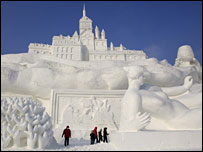
A famous ice festival in China is the latest victim of rising global temperatures. Every winter tens of thousands of tourists go to Harbin, in the far north east of China, to see the city's ice sculptures. But with higher temperatures, the sculptures are starting to melt. This report from Michael Bristow: Harbin is one of China's coldest cities. In winter, temperatures can drop as low as minus 35 degrees centigrade. Despite this harsh climate, the city has turned itself into a popular winter tourist destination. Visitors arrive from across Asia to experience the cold - and see the city's ice sculptures. Animals, people, even famous buildings are turned into intricate sculptures that are lit up at night. But, there's a problem - winters just aren't as cold as they used to be. Last year, Harbin had its warmest year since records began. And that means the city's famous ice sculptures are melting earlier. The ice festival traditionally lasts until the end of February. But this year, there are fears the ice will have melted long before then. And this is not just a worry for environmentalists. Harbin's ice festival is the city's biggest source of income. If the ice goes, so do the tourists. Michael Bristow, BBC News, Beijing temperatures can drop as low as harsh has turned itself into tourist destination ice sculptures intricate sculptures since records began melting environmentalists income Try a comprehension quiz based on this story |
LATEST STORIES 27 May, 2011 Destruction of smallpox virus delayed 25 May, 2011 Micro-finance 'misused and abused' 20 May, 2011 Lonely planets 18 May, 2011 Germany to invest in more electric cars 16 May, 2011 Argentina builds a tower of books Other Stories | |||||||||||
Useful links | ||||||||||||