| | | | | | | ||||||
| | |||||||||||
Learning English - Words in the News 05 December, 2005 - Published 16:56 GMT Red Cross debates new sign | ||||||||||||
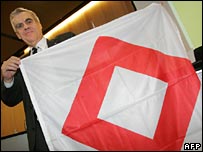
Countries who have signed the Geneva Conventions are meeting in Geneva today to discuss a third sign for the International Red Cross. Some countries want a new sign with no religious links. This report from Imogen Foulkes: The only emblems recognised under the Geneva Conventions are the red cross and the red crescent. On the battlefield or in disaster zones the thinking goes: these two clearly symbolise neutral humanitarian relief and should not be compromised by lots of other emblems. But Israel rejects the cross and the crescent, it's Magen David Adom Society uses the unrecognised red star of David. That means the society is not a full member of the Red Cross movement. America has been withholding its subscriptions to the International Red Cross in protest at the exclusion. Arab states meanwhile, will not accept the star of David as a neutral symbol in a war zone. The only solution is a third emblem, a red diamond on a white background, it has no cultural or religious significance. After intense negotiations, Israel says it will use the diamond outside its internationally recognised borders. But the new emblem still has to be approved. Although a majority of countries are in favour, some Arab states are apparently not convinced that Israel needs to be accommodated in this way. The debate in Geneva may be heated. emblems the Geneva conventions On the battlefield or in disaster zones the thinking goes clearly symbolise neutral humanitarian relief compromised unrecognised withholding its subscriptions to the International Red Cross it has no cultural or religious significance to be accommodated The debate in Geneva may be heated |
LATEST STORIES 27 May, 2011 Destruction of smallpox virus delayed 25 May, 2011 Micro-finance 'misused and abused' 20 May, 2011 Lonely planets 18 May, 2011 Germany to invest in more electric cars 16 May, 2011 Argentina builds a tower of books Other Stories | |||||||||||
Useful links | ||||||||||||