 | | | | | | | |
| Words in the News
Wednesday 21 August 2002
Vocabulary from the news. Listen to and read the report then find explanations of difficult words below.
| |
|
| |  | | |
Better rice, less global warming
Summary: Rice plants which produce higher yields make less of the greenhouse gas methane, researchers have discovered. Scientists say their finding could lead to new varieties of rice which make more grain and contribute less to global warming. This report from Richard Black:
| | |
|
| | The News | |
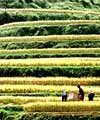
| | | Methane is the second most important greenhouse gas after carbon dioxide, and rice fields are among the biggest sources of methane. It's produced by a bacteria living in the wet soil of the paddy-field.
Now scientists from Europe and the Philippines have discovered that less methane is made in fields where the plants are producing more grain. The reason is that making methane needs carbon.
Plants absorb carbon from the air. They use some for making grain and some finds its way to the roots and then into the soil, where the bacteria can use it to produce methane. So if more carbon is tied up in making grain, there's less in the soil, which means less methane.
Rice is the staple food of half the world's population. But yields vary widely from region to region, and in some places, they're falling. A few months ago, to great fanfare, scientists unveiled the genome sequence of rice -- a tool of great potential use to researchers trying to develop new strains of rice with higher yields.
This latest research will now help steer scientists towards the genes they must work with if they want to design those new high-yielding strains without contributing to global warming.
Richard Black, BBC
| | |
|
| | The Words
| |
| | | greenhouse gas
a gas that may cause warming of the Earth's atmosphere
| | |
| | | paddy-field
a flooded field where rice is grown
| | |
| | | tied up
busy or occupied
| | |
| | | staple food
a basic part of the daily diet
| | |
| | | yields
an amount of food produced by a plant
| | |
| | | to great fanfare
with a lot of publicity
| | |
| | | unveiled
revealed
| | |
| | | genome sequence
the genetic information that describes a human, animal or plant
| | |
| | | tool
an instrument used for doing something (here refers to 'genome sequence')
| | |
| | | steer
to guide something or someone in a certain direction
| | |
|
|
| | Read more about this story | |
| | Other Words in the News archives | |
|





