 | | | | | | | |
| Words in the News
Wednesday 26 December 2001
Vocabulary from the news. Listen to and read the report then find explanations of difficult words below.
| |
|
| |  | | |
Radio's first 100 years
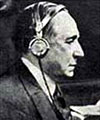
Summary: On Wednesday 12th December 1901 an Italian engineer, Guglielmo Marconi, made the first international radio broadcast, sending a signal across the Atlantic from the coast of Cornwall in the extreme south west of England to Newfoundland in Canada.
| | |
|
| | The News | |
| | | In 1897 Marconi had demonstrated that electromagnetic radio waves could be sent over short distances, but transmitting across the Atlantic was to show the potential commercial use of this technology and challenge the conventional scientific wisdom of the time.
Building the transmission site on a windswept Cornish cliff top proved to be the most time consuming part of the project. Each piece of equipment had to be hauled there using a horse and cart. Initially the site was dominated by a huge array of aerials, twenty masts each sixty metres high arranged in a circle. But these blew down in a gale and were replaced with a much simpler design using four posts.
Marconi travelled to St Johns in Newfoundland, Canada where he set up a receiving station in an old military hospital looking out to sea. The aerial to pick up the transmission was simply a long piece of wire attached to a kite.
The Cornish station sent its signal. Marconi heard the simple message dot dot dot, the Morse code letter S.
It had been thought that electromagnetic radio waves would travel only in straight lines, and so not be capable of covering huge distances. But with the success of the experiment Marconi demonstrated that they would bend, following the curvature of the earth.
His discovery was hailed as revolutionary. Until then all long distance signals had been transmitted through telegraph cables. The potential of this technology was quickly realised and led directly to the development of television and radio.
Julian Siddle, BBC
| | |
|
| | The Words
| |
| | | electromagnetic
magnetic forces and effects produced by an electric current
| | |
| | | potential commercial use
could be used to generate a profit
| | |
| | | conventional scientific wisdom
what most scientists believed at the time
| | |
| | | array of aerials
a number of aerials (pieces of wire that receive radio or TV signals) linked together
| | |
| | | to pick up the transmission
to receive or hear the transmission
| | |
| | | Morse
international code for messages - letters are represented by dots and dashes
| | |
| | | demonstrated that they would bend
showed that they would curve and were not just straight
| | |
| | | curvature of the earth
a smooth bending line - part of the earth's circumference
| | |
| | | potential of this technology:
what the technology is capable of becoming and doing
| | |
| | | realised
if something is realised it actually happens
| | |
|
|
| | Read more about this story | |
| | Other Words in the News archives | |
|





