| | Words in the News |
INTRO | | 12 and 13-year-old children have pre-set images of what a mathematician looks like, and it's not a very attractive picture. Professor John Berry from Plymouth University reports on his findings. |
IN FULL | |  | Listen to the report in full |
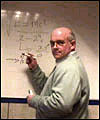 |  | 4th January 2001 An image of a mathematician? |
|
NEWS 1 | | | Listen to the first part of the report |
| | | Is the unflattering image perhaps accurate?
It is accurate from their perspective because I think they don't know what real mathematicians do and when we carried out an intervention strategy of producing a panel of mathematicians then the children were quite surprised that mathematicians are in fact ordinary people. It is just that they are very good at mathematics. |
WORDS | | their perspective: from their way of thinking
mathematicians: a mathematician studies problems involving numbers and calculations
intervention strategy: a plan to change the situation by getting involved in it panel:a small group of people who are chosen to do something
ordinary people: people who are not seen as 'different'
just: what makes mathematicians different is not very important |
|
| NEWS 2 | | | Listen to the second part of the report |
| | | Was Professor Berry surprised by the similarity in images from children from different countries (Britain, Sweden, Norway, Finland, Germany, Romania and the United States)?
We were surprised at the similarity yes. We weren't surprised with the images that we had from the United Kingdom and the United States because we've been working with children for a long time and I think our countries are very similar in the negative attitudes that people have towards mathematics. A teacher from Thailand contacted me via the email and said that she had carried out the same test and to her surprise they came up with the same features, the same sort of caricature as we had described. |
| WORDS | | surprised: this was an unexpected result
negative attitudes: a non-positive way of thinking or feeling
towards: if you have a particular attitude towards people, you feel like that about them carried out: you carry out a piece of research
caricature: a drawing or description that exaggerates an appearance, to make people laugh. |
|
| | | Read about the background in BBC News Online |
|





