Just below Edinburgh Castle, at the western end of its main street, Princes Street, there is a small tower. It is at the entrance to St Cuthbert's churchyard. Probably even most local people do not know its connection with medicine. Edinburgh holds a particular place in medical history because of the pioneering work at the University in the teaching of anatomy. This, too, had its unusual aspects. In the 18th and early 19th centuries, a father, son and grandson, all named Alexander Monro, formed a dynasty of professors in charge of anatomy for an unbroken 126 years. But there was a dark side. Studying anatomy required dissection. Dissection required bodies. Normally those were criminals who had been hanged. But not always. A body could be sold to the anatomy school without questions being asked. The first Alexander Monro worried in 1725 that "the requirements of anatomical teaching provided unscrupulous criminals with a particularly macabre opportunity for illicit gain." 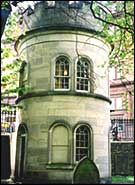 That was why watchtowers - such as the one surviving in St Cuthbert's - were built: to prevent newly-buried corpses being stolen. But people's greatest fear was of what might happen if there were no bodies... That fear became real in 1828 with the notorious case of Burke and Hare. Having legally sold one dead person to the university, they went on to sell another sixteen. Unfortunately, all of those had been alive until they met the two murderers. That was why watchtowers - such as the one surviving in St Cuthbert's - were built: to prevent newly-buried corpses being stolen. But people's greatest fear was of what might happen if there were no bodies... That fear became real in 1828 with the notorious case of Burke and Hare. Having legally sold one dead person to the university, they went on to sell another sixteen. Unfortunately, all of those had been alive until they met the two murderers.
An exhibition in the Sir Jules Thorn Museum in the Royal College of Surgeons tells the story of the surgeons and anatomists in Edinburgh. See vocabulary 
Exercise - Comprehension Look at the statements below, according to the text are they true or false?  Check your answers Check your answers
Links for more information
Royal College of Surgeons - museums
The BBC is not responsible for the content of external websites. | 


