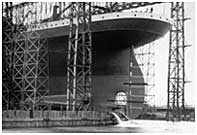
| Belfast's position on the River Lagan and at the head of a lough open to the sea helped shipbuilding become one of the city's major industries. Although a whole series of successful ocean liners were built at the Harland & Wolff shipyard, it is best known for building the Titanic. At that time the largest liner in the world, she sank in 1912 on her maiden voyage across the Atlantic. An iceberg tore an underwater gash in the ship's side 100m long. The activity in Harland & Wolff's shipyard today shows how our relationship with the sea has changed. Now oil rigs dominate the skyline. Belfast, as Ireland's only industrial city, is not just famous for its shipbuilding, however. For hundreds of years, linen has also been produced here, first as a 'cottage industry' carried on at home, and then in factories. Linen, derived fromflax, is one of the oldest materials known to man. Some linen cloth used in mummification has been identified as 4,500 years old. Many of the buildings in central Belfast, especially former warehouses in Linen Hall Street and Franklin Street, reflect the heyday of linen manufacture. But it is not a dead industry. Many of the factories that were out in the countryside to the south have gone, but one of the oldest, Thomas Ferguson in Banbridge, is still active and successful. See vocabulary 
Exercise - Comprehension Look at the statements below, according to the text are they true or false?  Check your answers Check your answers
Links for more information
Ulster Titanic Society
The BBC is not responsible for the content of external websites. | |