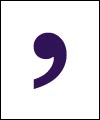
| Commas 1. Commas are used before the relative pronouns which or who only in non-identifying relative clauses where the information given is clearly extra to that given in the main clause. In identifying relative clauses, where the clauses are a necessary part of the nouns they describe, they are not used. Compare:- 'Sarah, who came on holiday with me to Switzerland last summer, is going to study anthropology at the University of Manchester.'
- 'This book, which was discovered in the ruins of a farmhouse in Wales, is over four hundred years old.'
- 'The boy who introduced me to the man I married has now married my cousin.'
- 'The book that he discovered in the farmhouse in Wales is now worth a lot of money.'
2. I think I remember that in reported speech in German, commas are used before noun clauses that begin with that, what, where, when, etc. In English they are not:- 'I had no idea where to find the Ministry of Sound nightclub.'
- 'Let me know what you plan to do when you get to London.'
- 'I wondered whether I would get an invitation to Hugo and Sally’s wedding.'
- 'He maintained that he was innocent, but I knew that he was guilty.'
Note that co-ordinate clauses connected with and, but or or (see above) are usually separated by commas. 3. In conditional sentences, they are used after the if clause when the subordinate clause comes first, but if it comes second, they are not always used. Compare:- 'If Henry rings, tell him I’m not at home.'
- 'I decided I would not answer the phone if he rang.'
4. They are used to separate items in a list, but not between the last two items: - 'As a student, I am always short of money, so when I go to the supermarket, I can never afford to buy mangoes, grapefruit, steak, veal, ice cream or ready-made meals.'
5. Adverbial clauses, phrases and expressions are separated by commas, particularly when they are placed at the beginning of sentences. As is the case in all of these examples, they reflect pauses in speech: - 'Easter week, as everybody knows, changes from year to year. This year it is very late.'
- 'In my view, he is innocent. However, in the jury’s opinion, he is guilty.'
|