have + object + infinitive / -ing form This special usage of the verb have means 'to cause to happen' or 'to experience'. There is often little or no difference in meaning between the two forms, e.g.: - He had us wash the dishes after supper.
- He had us washing the dishes after supper.
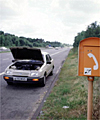
When we choose the infinitive, we are pointing to things that happen, or (have) happened or might happen. In your own example, 'I've never had my car break down on the motorway' you are saying that it has never happened, so you chose the bare infinitive. When we choose the -ing form, we are thinking of things that are happening, were happening or might be happening. Depending on how we are thinking about it causes us to choose one or the other. Compare the following. In the first three examples you can visualise things that are happening or were happening, so the continuous form works best: - Now that the epidemic is over, it's lovely to have rabbits running around in the fields once again.
- I opened the bonnet of the car and saw that I had water dripping out of the radiator.
- The way he told the story was so funny. He had us literally crying with laughter.
- You really ought to have the chemist take a look at that wasp sting. It looks really nasty.
- He had us prune back all the shrubs so that they didn't overhang his neighbour's garden.
- I'm ready to see him now, Geraldine. Have him come in, please.
|