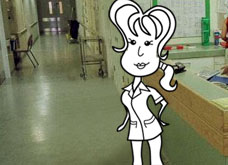
| We use the present perfect to talk about something that happened before now but we don't say exactly when it happened. Alice says, 'She has gone for a break'. The doctor isn't in the room now because she left the room for her break some time before now.
The father says, ' He's stopped breathing'. The patient isn't breathing now because he stopped breathing at some unknown time in the past. If we refer to the time when the doctor left the room or when the patient stopped breathing, then we use the past simple. She went for her break at midnight.
He stopped breathing 1 minute ago. The present perfect has two parts - the main verb and the auxiliary verb.
| |
| He has stopped breathing.
She has gone for her break. In these examples, the main verbs are 'to stop' and 'to go'. We use the past participle of the main verb. Some verbs are regular - you add 'ed' to the infinitive without 'to', while others are irregular. You have to learn the past participle e.g. to go - gone to take - taken to find - found
to see - seen to give - given to buy - bought
|
| The auxiliary verb is 'to have'. When we make the present perfect we use the present simple form of 'to have':
I/you/we/they have .
he/she/it has. The form is often shortened to: I've, she's, we've, etc.
She has gone for a break.
She's gone for a break. We use the auxiliary to make negatives, questions and short answers. I haven't done it before.
Has she done it before?
Yes, she has.
No, she hasn't.
|
| There are some adverbs of time that are commonly used with the present perfect. Just - This means it happened recently, not a long time ago
She's just gone for a break. Never - This means it has not happened, not even once.
I've never given mouth to mouth. Already - This emphasises that something has happened before now
I have already called the doctor. She is coming. The adverb goes between the auxiliary verb and the main verb.
|
| You can hear a pin drop (idiom): It is very quiet To catch up on something: To do something which you have not had time to do recently Mouth-to-mouth: A shortened version of mouth-to-mouth resuscitation - trying to help someone when s/he has stopped breathing by breathing into her/his mouth
|
| | | Last 3 episodesLast 3 language pointsLast 3 quizzes |
|