
 |  |
 |
| WORLD |
| REGIONS |
Americas Asia-Pacific Europe Middle East South Asia |
| SERVICES |
Contact Us Help Text Only Daily E-mail News Ticker Mobile/PDAs |
| | |
| You are in: | | Front Page > Europe > New Europe |
| ||
 | ||||||||||||
| 23 December 2002 - Published at 16h46 GMT | ||||||||||||
| Negotiating EU membership | ||||||||||||
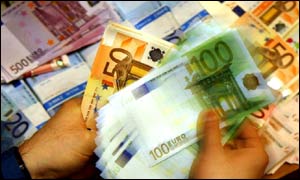 One billion more!!! | ||||||||||||
The European Union's Copenhagen summit in mid-December 2002, agreed that 10 new countries could join the EU. Enlargement itself has been scheduled for May 2004. The different countries' negotiating styles showed how difficult it may be to make deals in an enlarged Europe. Slovakia's chief negotiator, Jan Figl, had no inhibitions talking about money: "For Slovakia, it means 175, 291 and 354 million euros in the first, second and third year after accession..." ...In contrast to Hungary's Endre Juhasz, who prefers to remain tight-lipped:
One of the tangible steps achieved without much publicity by the poker-faced Mr Juhasz was an agreement to extend restrictions on the sale of Hungarian land to foreigners from 7 to 10 years. Brinkmanship Over the last years, candidate countries have repeatedly tried to present a united front. But their interests are too diverse. What can Malta, a small and rich Mediterranean island, agree with the biggest applicant, Poland, a poor central European country, where one in four people live off the land? Despite an improved financial offer by Denmark, Poland's chief negotiator, Jan Truszczynski, is holding out for more: "On the basis of this offer, can you conclude negotiations before Copenhagen?" "No, no..." "How much more do you want?" "I will not tell you that, I'm very sorry". Privately, EU diplomats are exasperated by Poland's bullish attitude. 'They're running into a wall', one diplomat says - 'they think they're the only country in the world'. However, Poland's powerful farming lobby is in a sour mood - and the government needs to be seen to be putting up a fight. Diplomatic Czechs
"You can't have too many priorities in the endgame. Let's be realistic. I think the Union won't offer more after Copenhagen than it will offer before Copenhagen". Danish predicament Denmark, the summit host, is also taking a big risk. Last month, the Danes, without consulting their EU partners, offered the candidate countries improved terms - including a net increase of over one billion euros in aid. The Danish ambassador to the EU, Poul Skytte Christofferson, found himself under attack from colleagues, who thought the offer too generous, and candidates, who thought it too mean: "I sincerely believe", Mr Christofferson says, "that this is a fair deal. I have great understanding for the problems which the candidate countries are facing". Just wait till they join!!
"There are plenty of tales, for instance, of Polish ministers indicating to relatively senior Commission officials that once Poland's in, there will be scores to be settled." But he says he has also witnessed resentment building up between candidate countries themselves - for instance, on road transport negotiations: "Hungary, Slovakia and the Czech Republic were all aiming for the same result, more or less. But then, at one of the negotiating sessions, Hungary and Slovakia decided they would settle on a deal, leaving the Czech Republic still waiting to sort out its problems - and it's still waiting..." Peter O'Donnell thinks that, in practice, there will not be one group of new member states - simply a very diverse EU of 25 states, with each fighting for its own interests. | ||||||||||||
| ||||||||||||


| | |
| EUROPE NEWS |  | |
| ||
 | Russians in Ukraine 'by accident' | |
| French ministers quit in economy row | |
| Salmond and Darling in heated debate | |
| | |
 New Europe Home  | ||
 Europe Today | ||
 Network Europe | ||
| |
| Related stories: | |
 | |
| 30 Apr 2001 |
| A - Z of Europe - European Union | |
| 11 Dec 2002 |
| EU in search of natural boundaries | |
| 11 Dec 2002 |
| Euro leaders prepare to make history | |
| 11 Dec 2002 |
| Bush backs Turkey's EU efforts | |
| |
| External Links: | |
| |
| EU Commission: Enlargement and Candidate Profiles |
| Office of the Cyprus Negotiators |
| |
| The BBC is not responsible for the content of external internet sites | |
| |

