
 |  |
 |
| WORLD |
| REGIONS |
Americas Asia-Pacific Europe Middle East South Asia |
| SERVICES |
Contact Us Help Text Only Daily E-mail News Ticker Mobile/PDAs |
| | |
| You are in: | | Front Page > Europe > New Europe |
| ||
 | ||||||||||||
| 06 November 2002 - Published at 17h31 GMT | ||||||||||||
| NATO breaking in new troops | ||||||||||||
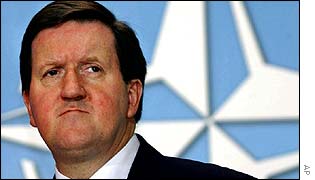 Nato Secretary General Lord Robertson; the alliance is preparing to take in new members | ||||||||||||
Three years ago, America's President Bill Clinton welcomed the accession of the three Central European states to NATO as the righting of an historical injustice: "Today we are joined by the leaders of Poland, Hungary and the Czech Republic, whose descent into darkness helped to spark NATO's creation. So we say, welcome to NATO, welcome home to the community of freedom"
Much to do Restoring pre-war regimental traditions and sending a few younger officers on English-language courses are not enough to create a Western army. Jonathan Eyal of the Royal United Services Institute in London explains. "The Polish army continued to be a repository of national identity in an almost unique way in Central Europe. But the Czech military remained an utter joke," he says. "Because of Hungary's very rapid economic strides, the Hungarian military found itself unable to recruit anyone of quality... and ended up in a terrible downward spiral". At best, he thinks, NATO could make use of 20,000 troops from the three countries combines - 3 to 5 per cent of their total force. Resentments
"A pilot does what he is told. Pilots are pilots and politics are politics. For the proverbial "bottle of vodka" we could have got our hands on entire aircraft. But because we treated our old friends like dirt, they vandalised the airfields and took away their planes. I'll never live it down". Eager but inexperienced Jonathan Eyal says younger officers from Central Europe are often less jaded than their Western counterparts, but they lack experience: "Knowledge of coalition warfare is often very poor. Ability to execute military manoeuvres is rather limited. The level of education, formally very high, is in practice rather inferior," he says. "The inability to take decisions or to take responsibility is a feature of the former Communist military and is duplicated throughout civilian life." Nevertheless, Poles, Czechs and Hungarians have given crucial help to NATO's operations in the Balkans - not just in providing military units and medical facilities for peacekeeping operations In Hungary's case, it's also given access to intelligence sources in Yugoslavia. Nato's unanswered questions On matters of immediate concern to the United States, like last year's terrorist attacks on New York and Washington, the Americans have preferred to act alone. NATO has been sidelined.
"What is NATO supposed to do? If you could answer that, then perhaps, as a Czech military planner, you could plug yourself into the bigger picture." Jonathan Eyal suggests just being in NATO is important enough: "The military of Central Europe are in the game not because they know what they want, but because they want to be sure they are involved in whatever ultimately emerges." Or as Janos Szabo, head of Hungary's Strategy and Defence Studies Institute puts it: "We want to be a member of the European security architecture - and not just a child under it". | ||||||||||||
| ||||||||||||


| | |
| EUROPE NEWS |  | |
| ||
 | Russians in Ukraine 'by accident' | |
| French ministers quit in economy row | |
| Salmond and Darling in heated debate | |
| | |
 New Europe Home  | ||
 Europe Today | ||
 Network Europe | ||
| |
| Related stories: | |
 | |
| 16 Oct 2002 |
| Nato - what future, what role? | |
| 16 Oct 2002 |
| Europe urged to boost Nato spending | |
| 25 Sept 2002 |
| Nato warms to rapid reaction force | |
| 01 Sept 2002 |
| Analysis: Pressures of peacekeeping | |
| |
| External Links: | |
| |
| Nato |
| Nato Prague Summit |
| |
| The BBC is not responsible for the content of external internet sites | |
| |

