
Last updated: 13 july, 2009 - 08:09 GMT
Rising food prices remain a problem
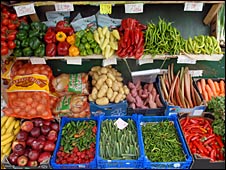
Food prices remain a concern for many
Whatever happened to worries about the rising cost of food?
This time last year the world was grappling with unprecedented increases in the cost of staple products we all consume to stay alive, says the BBC's international business reporter, Mark Gregory.
There were riots in some countries. Since then food prices have rather dropped off the news agenda.
Media attention has switched to other economic concerns such as the global banking crisis and the onset of recession.
But this does not mean the problem has gone away. The BBC's own research suggests rising food costs remain a headache for lots of people in lots of places.
To play this content JavaScript must be turned on and the latest Flash player installed.
World food prices
For the last 12 months the BBC World Service Food Price Index has been tracking food prices in eight cities, including Washington DC, Delhi, Jakarta and Brussels.
Each week reporters head to the shops to record the prices of some staple products.
By mid-June, overall prices had risen by just under 5% across all the cities over the period of the survey. But there are some striking variations.
In Nairobi, our index suggests food prices rose by nearly a third. In Buenos Aires the figure was almost 20%. Both these cities are in the developing world.
However, in the two wealthiest cities, Washington and Brussels, the cost of staple products actually fell sharply - by 17% in the US capital and by 10% in Europe's hub.
Other cities clustered around the average all showing slight rises in the price of staple foods. Our survey is not comprehensive but it may provide useful information on underlying trends.
We want your views
So it is a complex picture with no easy answers. Why should food prices by falling in rich cities but rising in poorer ones such as Moscow, Delhi and most dramatically Nairobi?
We want to know what you think. click
Please write or email us with your experience of what has been happening to food prices where you live.
Your thoughts will be fed into our research as we compile special programming on food prices next week.
It is the latest in the BBC's Taking the Pulse of the Global Economy, which looks at how the big economic issues are affecting people's lives around the planet.
First broadcast on 7 July 2009


Highlights






BBC iD
BBC iDBBC navigation
BBC links

BBC © 2014The BBC is not responsible for the content of external sites. Read more.
This page is best viewed in an up-to-date web browser with style sheets (CSS) enabled. While you will be able to view the content of this page in your current browser, you will not be able to get the full visual experience. Please consider upgrading your browser software or enabling style sheets (CSS) if you are able to do so.
