
In 2008, there were food riots in many developing countries, after prices for some staple foods such as rice and grains doubled, partly because of record high prices of oil.

An Indian woman gathering wheat in a field near the village of Jajjal, India

Later in the year, the financial crisis took a turn for the worse, the price of many commodities started falling, and some people assumed that food prices would naturally drop back to more normal levels.
BBC World Service has been tracking food prices in eight major cities for its own World Food Price Index.
It shows that in 2009 in some cities in developed economies, food prices have begun to fall. One such place is the Belgian capital, Brussels, as the BBC's Ben Shore found out from shoppers.
Listen Listen to Ben Shore's report from Brussels, Belgium (1 min 55 secs)
End of Section
Rising prices
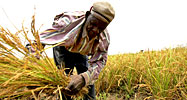
A Burkina Faso farmer harvests rice
However, according to the UN Food and Agriculture Organisation, staple foods still cost twice the level that they did at the beginning of 2008. In countries such as Afghanistan, Eritrea and Ethiopia, and that's having a huge effect on vulnerable people.
The BBC's food price index also reveals crucially that in some parts of the developing world, such as Nairobi in Kenya, prices have not fallen. Indeed some prices have gone up, as the BBC's Anne Mawathe reports from Nairobi.
Listen Listen to Anne Mawathe's report from Narobi, Kenya (4 mins 51 secs)
End of Section
Underlying reasons
So what is driving these discrepancies in food prices across the world? It is not just about local reasons, such as the drought in Kenya. We heard from Alex Evans, who is from the Centre on International Cooperation at New York University. He's worked with the United Nations and the British government. He explained what is driving these discrepancies in food global prices.
Listen Listen to Business Daily's interview with Alex Evans (6 mins 1 sec)
End of Section
Profiteering farmers?

Thailand's rice crop is a crucial export for the country
So who has been profiting from food prices which in many parts of the world have stayed stubbornly high? Farmers and traders have been accused of profiting. However, many of them deny this fiercely, saying that they've actually lost money because of the volatility of markets for food such as cereals and grains and because of the high cost of fertilisers and fuel.
But what is the truth? The BBC's Jonathan Head in Bangkok has been trying to track down the people who made money out of record high rice prices, in Thailand, the world's biggest exporter of rice.
Listen Listen to Jonathan Head's report from Bangkok, Thailand (3 mins 2 secs)
End of Section
Business Daily first broadcast on 13 January 2009

