Wednesday 03 October, 2001
Artists of conflict
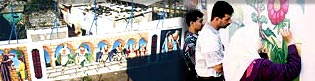
A year after the intifada against Israeli rule, many paintings, frescoes, murals and banners have appeared on the streets and buildings of Gaza City.
Arts In Action discovers what part these paintings play in allowing those living in this part of the world to creatively express fears and frustrations.
By the time Palestinian leader Yasser Arafat and Israeli Foreign Minister Shimon Peres met to discuss a ceasefire in the Gaza Strip in September 2001, more than 600 Palestinians and 170 Israelis had been killed in the violence of the previous 12 months.
Now one year on since the intifada, or uprising, began, the anniversary has been marked perhaps typically with rioting, but also in more creative ways, as forms of militant art have also been unveiled in the Gaza Strip.
Gaza City

A huge set of murals has sprung up in Gaza City, displaying a variety of scenes and figures - literal or abstract representations of the Palestinian conflict with Israel.
Emotional and economic stresses are conveyed. Traditional Palestinian symbols are painted next to images of grieving mothers, whilst portraits of children are depicted against the backdrops of struggling industries.
In the year since the outbreak of the intifada, living standards among Palestinians in the West Bank and Gaza Strip have dramatically fallen.
According to a report by the Palestinian Economic Council for Development and Reconstruction, the military blockades erected in the region, have had a severe impact on the economy. It puts the total loss in all economic sectors at $4.25bn dollars during the period between September 2000 and September 2001.
| ‘The Palestinian authorities have estimated that a third of the population of 3.2 million are living below the poverty line – on under six Shekels ($1.5) a day.’ |
|
Murals
So how can art help? What purpose can a fresco culture serve within the Palestinian community in Gaza?
Dr Eyed al-Saraj runs a mental health project in Gaza for young people. He uses art as a means of releasing the personal stress and trauma created by the political situation in the occupied territories.
He believes that such creative releases are crucial:
‘Many of the children who have come for treatment have had the chance, sometimes for the first time in their lives, to express themselves as a communal activity – this is new.’
Claiming that, ‘you can see and feel the pain in these paintings’, in Dr Eyed al-Saraj’s view, painting can provide a necessary means of self-expression for the children who are unable to verbally express their feelings.
Political painting
However, critics may argue that such images are nothing more than primitive political slogans and that these forms of “self expression” are not genuinely spontaneous, but part of a crude recruitment programme for military groups.
In answer to the critics, Dr Eyed al-Saraj comments:
‘From my experience these painful expressions of Palestinians are common. The rest of us are doing this through demonstrations, some are doing it through bullets and through throwing stones, but that doesn’t mean that we belong to a political party.’
| ‘The quest here is a national quest for freedom and everybody is a subscriber.’ |
|
Loss of innocence
For many of us, it may be difficult to understand how a child’s emotional stability can be so inextricably linked to a region’s political situation. But in an area that has seen the destruction of homes, a dramatic rise in unemployment and has witnessed daily violence, perhaps it is little wonder that many children have lost their sense of innocence.
In Dr Eyed al-Saraj’s opinion, every aspect of daily life in Gaza has political undertones and so, as he explains, it is unsurprising that the art from this region is so heavily weighted. He explains:
‘It is the sad thing that sometimes we don’t have childhood here. Everything here is related to the political situation for the last 53 years.’
| ‘The water we drink is political, the air we breathe is political and even our movement is political as today we can not leave Gaza.’ |
|
‘Gaza is like a prison and this affects every individual here and so it is not surprising that people express political messages through their art.’
|  |  | | | Suicide bombing show |  |
| | In September 2001, Palestinian leader Yasser Arafat, personally intervened to ban an art exhibition in the West Bank town of Nablus.
It was a lurid recreation of the scene of the attack on the Sbarro Pizza house in Jerusalem in which a Palestinian suicide bomber killed 15 Israelis.
The room-sized installation had broken tables splattered with blood and fake body parts and included a portrait of the bomber holding a Koran and a rifle.
An official said that Mr Arafat was ‘gravely disturbed and offended by the images in the exhibit.’
Meanwhile supporters of the show hoped that it highlighted public feelings about such attacks. As Alas Hmeidan, head of Islamist students at the local university explained, ‘We don’t like blood, but this is a way to retaliate against the massacres committed by Israel.’ |
|  |
|