Monday 17 September, 2001
News in pictures
The dramatic images of the World Trade Centre's towers collapsing in New York, after they were hit by the hijacked aeroplanes has filled newspapers and television screens around the world.
Pictures of people falling to their death, of the emergency services trawling through the rubble in the desperate search for life and of the devastated New York skyline are imprinted on the minds of all of us.
These are images that we are unlikely to forget, but why is it that pictures often speak louder than words? And is there a danger of audiences reaching image overload? Arts In Action reports.
The dramatic and horrific images of passenger aircraft striking the twin towers of the World Trade Centre in New York will no doubt endure long in the minds of all who have seen them.
The fact that the attack and subsequent collapse of the skyscrapers was recorded live on television guarantees the event a macabre place in news history.
Moving pictures

Many of us live in a media world where news is flashed in front of our eyes as it breaks and so on 11th September 2001, thousands of people around the world watched on television as the proud twin towers became engulfed in flames before crashing to their knees.
We also saw how men and women chose to jump to their death rather endure the terror within the buildings and how the emergency services are now dealing with the aftermath of the single biggest act of terrorism the world has ever witnessed.
These images reduced much of the world to tears. But whilst there is a global audience that needs to understand the events, many may now be feeling emotional guilt for choosing not to watch the news reports - after all how many times can people view the scenes before they chose to switch their minds off from the terrible images that they have seen again and again?
Speaking to The New York Times, Barbie Zelizer a professor of communications at the Annenberg School at the University of Pennsylvania, has explained how important it is to people to watch television images of world events to lessen their feelings of helplessness. She explained:
| ‘Television provides a way of gaining control, a feeling that one is arming oneself with information that lessens the sense of helplessness. We needed to see this, and we needed to see this in repetition.’ |
|
Printed press
For anyone who watched the destruction of the World Trade Centre on television and commented that it was reminiscent of an action movie, there are still images that remind us that this tragedy is for real.
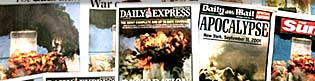
For the printed press, often pictures speak louder than words. Both in the UK and the US, reports have often been presented in pictures. Images of a grimacing New York skyline missing ‘its two front teeth’, as one reporter put it, provide the centre spreads of newspapers across the world.
Glaring out from front pages are the distraught faces of those who, still dazed, are now are searching for their loved ones.
Four days before the tragedy in America, British newspaper, The Guardian, reported on the divisions in Northern Ireland. In it the reporter commented how news photographs can open our eyes to events and how they can ‘expose the fact that hope has been betrayed again and again.’
The reporter would have had no idea of what was to unfold in the following weeks, but his words, unfortunately, have remained relevant.
Snapshots of history
But, as tragic as the events in America are, this isn’t the first time that photographs have lingered in our minds as snapshots of pain.
If we think of the Vietnam War many will recall the image of the naked child who ran along a street, screaming from the pain of the napalm that attacked her skin. Similarly, the shooting of JFK in 1963 is fixed in many minds as a still black and white image.
So why is it that when the television reports inevitably shift their focus it is these, and other terrible images, that are likely to stick in our minds?
According to British photographer Simon Norfolk, one of the prize-winners in this year's World Press Photo Competition, the enduring legacy of photographs lies in their ability to transcend an essence. He explains:
| ‘I remember the image of a man waving at a window, I remember seeing somebody cart wheeling through the air as they fell from a building, I remember the plane curving around as it hit. But I don’t remember these as a moving sequence.’ |
|
‘Photography is an essence, it is a concentration that TV footage, despite its omniscience, hasn’t really captured the crown in terms of distilling to an essence a moment in a news story and creating icons.’
Freeze Frame
There can be little doubt that reportage of the terrorism that has ripped New York apart is far from over and we will no doubt witness more images of pain and hurt before this chapter in history reaches it’s conclusion.
But for many people the events of the past week will be freeze framed in our minds for a long time to come. As Simon Norfolk comments:
‘News photography will record the events, it’s what we sit glued to, but I think that stills photography is how we will remember the events later. I think still photography is what makes history.’
|  |  | | | Internet searches |  |
| | As well as newspaper and television coverage, since the unprecedented terrorist attacks on the United States internet users have been turning en masse to search engines for information.
On the day of the attacks traffic to search engines and portals was reported to be up by about 10 times more than normal.
Across the web, virtually all search terms were related to the devastating attacks on New York and Washington.
The most popular news organisation searched on Lycos, as well as the Google search engine was CNN, followed by the BBC, MSNBC, and ABC News.
In the immediate aftermath of the attacks, the number of searches for links to CNN was about 160 times greater than would usually be expected during a 12-hour period. |
|  |
|