Saturday 27 January, 2001
The Life Of Lawrence
In his day his works were often thought to be obscene and yet, apart from Shakespeare, the works of DH Lawrence are the most widely taught English texts throughout the world. In Writers In A Nutshell leading experts discuss the influential artistic achievements of the controversial novelist sometimes known as “Dirty Bertie”.
Lawrence The Son
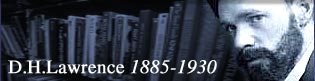
David Herbert Lawrence was born at Eastwood in Nottinghamshire, in 1885, the fourth of five children of coal miner Arthur Lawrence and his wife Lydia Beardsall. His parents marriage was unhappy and the children were brought up only to see their mother's point of view.
Delicate health meant that D H Lawrence stayed close to his mother. He was often ill and away from school and was bullied by other boys for his delicacy.
He won a scholarship to Nottingham High School and in 1901, when he left school at the age of 15, he found work as a clerk at Haywood's Surgical Garments factory in Nottingham. He hated the work and couldn't get on with his fellow workers, but by 1906 had saved the £20 fee to enable him to take up a teacher training scholarship at Nottingham University.
In 1908, he became an assistant master at Davidson Road Elementary School in Croydon at a salary of £95 a year, but he was lonely and unhappy there. After the death of his mother in 1910, he became ill and was advised to give up teaching.
"Is it a book you would wish your wife or your servants to read?"
Prosecuting Council referring to Lady Chaterley's Lover |
|
Lawrence The Writer
In 1911, his novel The White Peacock was published, followed by The Trespasser (1912) and Sons And Lovers(1913).
In 1912, Lawrence met Frieda Weekley, nee von Richthofen, the wife of a professor who had taught him. She was six years older than Lawrence and had three children. She found her marriage dull and had had several affairs. She and Lawrence eloped together and were married in 1914.
Their marriage was stormy and the War years were unhappy for them. Lawrence was declared unfit for military service (it was discovered that he had TB). Frieda's German nationality and Lawrence's outspoken criticisms of the War led to them being suspected as spies by their Cornish neighbours. Lawrence began to have ideas which appeared close to fascism and he was also anti-Semitic. Eventually, their house was searched and they were given three days to leave Cornwall.
Lawrence The Traveller
In 1919, they left for Italy. They were always on the move around the world and always short of money. In 1922, they travelled to Ceylon, Australia, USA and Mexico. In 1923, Frieda returned to England and Lawrence joined her later but he was miserable in England so in 1924 they returned to Mexico, where Lawrence hoped to set up his ideal commune - Rananim. The idea did not work. Lawrence fell ill, so they returned to Italy, finally settling near Florence.
Lawrence had become interested in painting and, in 1929, an exhibition of his work was held in London, which Frieda attended, as he was too ill to travel. The police seized 13 of the pictures as obscene.
Lawrence And The Lover
In 1915 The Rainbow had been seized by the police and declared to be obscene. His 1916 novel Women In Love could not find a publisher in America or Britain (and did not until 1920 and 1921 respectively when, in 1921, W Charles Pilley reviewed it under the headline "A Book the Police Should Burn"). So, in 1928 he arranged for a private publication of his novel Lady Chatterley's Lover in Italy. It was not to be commercially published in the USA or Britain for 30 years.
In 1960, the British publishers of Lady Chatterley's Lover, Penguin, were prosecuted by the Home Office for obscenity. The prosecuting counsel introduced the notorious question to the jury: "Is it a book you would wish your wife or your servants to read?". Penguin won and publication went ahead.
Lawrence died in a sanatorium in Vence, France on the 2 March 1930. The obituaries were largely hostile.
|  |  | | | Further Reading |  |
| | A selection of DH Lawrence's fictional work follows:
The White Peacock, 1911
The Trespasser, 1912
Sons And Lovers, 1913
The Rainbow, 1915
Women In Love, 1920
The Lost Girl, 1920
Aaron's Rod, 1922
Kangaroo, 1923
The Boy In The Bush, 1924
St Mawr, 1925
The Plumed Serpent, 1926
Lady Chatterley's Lover, 1928
The Escaped Cock (The Man Who Died), 1928/1929
The Virgin And The Gipsy, 1930 |
|  |
|