Turbulent times

Farai Sevenzo hears from Zimbabwe's top musicians on their active role in the current political turmoil.
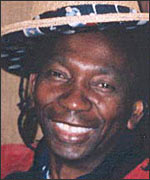
Thomas Mapfumo |
Songs from the country's liberation struggle prior to independence in 1980 are being played in Zimbabwe more now than ever.
"They are singing the same kind of stuff now against a black government as they sung against a white one," says Leo Hatugari, a music journalist with the Zimbabwe Daily News.
Songs like Mamvemve by Thomas Mapfumo, which means "this house that you are crying for has been turned into rags", has been banned from broadcast on state media.
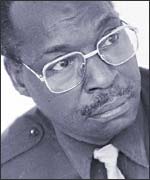
Leo Hatugari |
"The message that is being put across intensifies their anger to throw out this government. It is not soothing," says Hatugari.
The year 2000, in which Zimbabwe held its fourth general election in twenty years under the leadership of President Robert Mugabe has seen unprecedented violence over land issues and between political parties. Morale boosting
Thomas Mapfumo is the country's best known and most politically engaged musician. But even before him, music played an important role in the political life of Zimbabwe. The Zanu Freedom fighters drew on the country's cultural tradition and used songs as morale boosters and rallying cries.
"People give me such names as the Lion of Zimbabwe, and some call me Gandanga," says Mapfumo. The Rhodesian authorites had called the rebel movements maGandanga, meaning 'monsters'. But at the time the people of Zimbabwe embraced the word to mean what they thought it meant - freedom fighters.
Jamaican reggae star, Bob Marley, was actively involved in the struggle for independence and performed at the country's independence celebrations in April 1980. 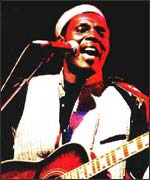
Oliver Mtukudzi: |
His 1979 track 'Zimbabwe' was immensely popular as a rallying cry. His style of protest song caught on with the African majority. The conditions that prompted people to write songs during the time of the independence war, according to Leo Hatugari, are almost identical to the conditions that people are finding themselves in now.
Symbols of opposition
In contemporary Zimbabwe the mood at concerts is one of defiance and bonding. Oliver Mtukudzi's Friday shows have begun to attract 'Tuku Groupies', who wave candles to the music and raise their open palms, a symbol of the opposition. Every song played is connected by fans to the country's current plight. "The mood of the nation right now is that they want change," says Mutukudzi.
While Mtukudzi and Mapfumo are considered veterans of the protest song, other groups are now lending their talents to the cause.
Andy Brown and his group The Storm produced a song, Nation of Thieves, that has been banned on state media. 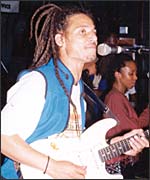
Andy Brown: banned |
"We are now a nation of thieves," says Brown. "They have been stealing all the money, so as a result the whole infrastructure is beginning to fall apart."
"There is no way musicians can be shut up," says Leo Hatugari "Even the Smith regime was trying the same things. They were banning songs."
"People are just impatient. They want change and the musicians are putting that through very eloquently - more eloquently than the opposition." |