Songs and Soldiers

Catherine Fellows investigates the role played by musicians in the December 1999 military coup in Ivory Coast.
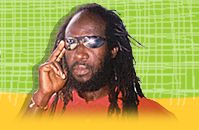
The ever-popular Ivorian reggae musician Alpha Blondy has been singing highly politicised songs with uncomfortable lyrics for many years now.
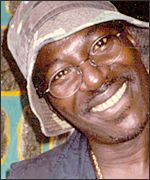
Alpha Blondy is an Ivorian national hero |
His track 'La queue du Diable' is typical of his biting commentary with its call for an increase in civil servants' and workers' salaries.
They are struggling to survive, sings Blondy, "while the government is holding conferences with champagne and caviar . . In another song, La Guerre Civile, Blondy predicted civil war if an elected president ignores the people's calls for change.
Well, it wasn't civil war, but I was as surprised as the next person to hear of a coup in Ivory Coast - one of Africa's more peaceful nations.
 | | Absolute power corrupts absolutely. An elected president can't be elected indefinitely. One day or another people will want change and then there will be civil war | | Alpha Blondy 'La Guerre Civile' |
| |
|
I was even more amazed to hear claims that the coup had been directly inspired by music. And that the soldiers immediately went to the homes of their musical heroes to celebrate what they saw as a joint victory. A new generation
At a production house in Abidjan I met a band called Sakholo.
Their name means "This is what they are" and they told me they represent a new generation which is positive about life and about Africa.
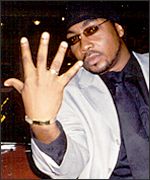
Rap star Angelo - part of a new confident generation |
They were supportive of the coup saying no-one had died and a fresh wind was blowing through the country.
And yes, they said, the musicians had played a part.
It is usual during a coup for the military to seize radio stations and broadcast to the nation.
In the case of Ivory Coast, the coup leader Robert Guei chose Radio Nostalgie - the country's foremost independent commercial music radio station.
In the months before the coup, when the country faced a series of student protests, the station was giving a platform to many musicians who were singing about the problems in society. This was in defiance of attempts by the government to silence its musical critics by banning their songs and videos from state radio and television.
Alpha Blondy, Tiken Jah, Tangara Speed Ghoda, Fadal Dey - all were being played on Radio Nostalgie, and the soldiers in the barracks were listening.
At dawn on 24th December, 1999, the soldiers burst into the station, where themanager, Yves Zogbo Junior, was on duty. "To tell you the truth I wasn't really frightened," he said.
"I'll tell you a secret, Robert Guei was a witness at my wedding! I said to him 'Uncle,not you!' and he said 'Yes, it's me!'. Then he sat down and gave his message to the nation."
Shaking hands
Alpha Blondy lives in the most extraordinary turreted fortress painted every colour of the rainbow and guarded by huge statues of St Anthony and the Virgin Mary. He told me he had been terrified when the coup was announced and surprised that soldiers had arrived at his gates with guns.
"I hid under my bed", he told me.
His daughter then told him that the soldiers just wanted to shake his hand.
"I told her 'this is Africa...people can change'. I didn't want to be crucified. "When they say my songs inspired the coup I say no. Alpha Blondy's strategy is to say the truth, not trying to create a revolution but trying to make people aware of the danger."
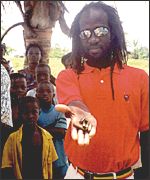
Tangara Speed Godha shows off 'shells of freedom' |
In Abobo, one of the largest ghettos of Abidjan I met Tangara Speed Ghoda, another of the artists whose songs were broadcast immediately after the coup.
He told me that it is his daily observation and experience ofthe neighbourhood's problems that gives his songs their power.
Tangara said the soldiers had visited him on the day of the coup and what struck him most was that when they fired their guns it was into the air and not at the people. In his hand, he held six bullets. He calls them 'the shells of freedom' and reckons they might be worth a lot of money one day.
Tribute to Guei
Serge Kassy is one of the most politically engaged reggae musicians in Ivory Coast.
During the previous regime several of his songs were banned, and he was physically attacked by police. He still has some nasty scars on his arm.
He wrote a song about Robert Guei following an incident in 1995 when the general refused a government order to suppress an opposition demonstration.
"I had no idea at the time that one day he would be president," said Serge. "It's not every General who would refuse to obey orders to fire on the people - it was a brave act. So since then we have remained good friends."
Kassy has even named his forthcoming album 'Mon General' as a tribute to Guei.
Of course, it is not just reggae artists who are challenging the status quo in the Ivory Coast.
A distinctively Ivorian musical style known as Zouglou is famous for its witty, satirical lyrics which grew up alongside the student protest movement.
"Zouglou was a fighting movement for people, especially for youth and students", said Charles Ble Goude, general secretary of FESCI, Ivory Coast's national student movement. 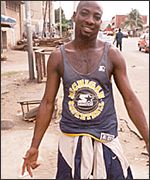
L'Enfant Siro of Zouglou stars Poussin Chocs |
One of Zouglou's exponents is Poussin Chocs led by L'Enfant Siro whose track 'Tu Sais Qui Je Suis' - do you know who I am - criticises former President Henri Konan Bedie's attempts to define Ivorian-ness on ethnic lines.
Overt support for the new regime also comes from top-selling duo Alan and Nicaise.
The title track of their album El Mutino presents Robert Guei as a Father Christmas in khaki, handing out brooms to all the soldiers so they can sweep Ivory Coast clean.
Exaggerated claims
But there is scepticism about the role played in the coup by musicians.
| | "Look, the musicians live among us. They know what we are going through. They are our messengers. They interpret what the population is thinking." | | Corporal in the Ivorian army |
| |
|
Constant Anaganou, marketing manager of Showbiz, Abidjan's largest music production house, flatly rejects the idea that music prompted the takeover.
"I think it's exaggerated", he said.
"The coup d'etat had nothing to do with music. Music can bring attention to certain things, I agree, but music cannot be the trigger. It can be one of the factors."
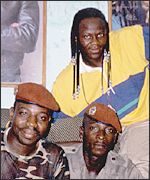
Coup soldiers share beer with reggae star Fadal Dey |
So what do the soldiers themselves think?
Fadal Dey, is a reggae singer whose music is supposed to have inspired the army and over an informal beer he introduced me to four of the soldiers who took part in coup.
"It could have been avoided if the authorities had listened to the musicians," one corporal told me, sitting under a huge poster of reggae legend Bob Marley.
"One day we just said enough is enough, the population is suffering, we soldiers also have our problems and really we have to do something.
"The musicians should know that their stories really provoked the army to do this - no individual could act so it really inspired us to get to where we are today." Warning against hysteria
But it won't be all plain, uncritical sailing for the new regime.
Soum Bill, lead singer of one of the most successful Zouglou groups, Les Salopards, told me his newly released solo album is as critical as ever.
"People let themselves be carried away by hysteria. Everyone shouted, welcoming the soldiers", he said.
"But we must speak out against the negative things happening at the moment - particularly during this time of reconstruction. They are cracking down on people indiscriminately.
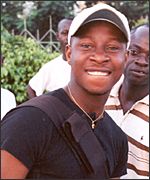
Soum Bil - don't get carried away |
"If there are thieves and bandits around we are all to blame. It's what the system produced. It's important to be tough but not to sacrifice the correct procedure. You musn't get carried away with hysteria."
And the last word to Alpha Blondy - the great survivor of Ivorian music.
Walking around Abidjan with him, it is clear that he has a huge popular following. Some have said that if he stood for President he would be unstoppable.
But he is clear where his priorities lie.
"I don't want to get involved in politics>" he says.
>"I told the soldiers, if you want me to be useful, let me be the way I am. I want to be a singer. To be able to criticise." Any new songs from the man they call the Grand Frere - Elder Brother? "Ah yes," he says. "A very beautiful one. It's called 'Digging My Way to the French Embassy" - so next time there's a coup I can follow the President's example and escape with my family." |