 | | | | | | | ||||||||||||||||||||||||||||||||||||||||||||||||||
| | |||||||||||||||||||||||||||||||||||||||||||||||||||||||
What's the big deal? | ||||||||||||||||||||||||||||||||||||||||||||||||||||||||
BBC Focus on Africa magazine asked people from both sides of the issue over Economic Partnership Agreements to take on each other's arguments. The full email exchange between Peter Hill, a member of cabinet to Peter Mandelson – European Commissioner for External Trade, the European Commission, Brussels and John Ochola, Programme Officer, Eco News Africa, Nairobi
There are two reasons we need EPAs. The first is a constraint. The second is an opportunity. The constraint is that the Cotonou arrangements are not compatible with WTO rules because they discriminate in favour of the ACP group over other developing countries. Other developing countries resent this and have successfully challenged Cotonou. We need to put EPAs in place by 31 December 2007 or the only legal alternative for ACP countries will be the EU's general system of preferences for all developing countries which offers less generous access for some important ACP exports like bananas. The Cotonou arrangements were well-intentioned, but have not helped to deliver development. Although the ACP countries have had better access to the EU's market than anyone else for over 30 years, their exports as a share of world trade have declined. They continue to depend on the export of primary commodities, whose prices are in long-term decline. EPAs offer the opportunity to replace this with progressive trade opening, regional integration, targeted development assistance and rules for good economic governance.
Yes the Cotonou agreement is not WTO compatible. However, the myth being peddled by the EC is that it is only EPAs that will bring about opportunities for poor countries like Kenya. Notwithstanding the ludicrously short time period and the EC insistence that the only legal alternative is the general system of preferences it is a fact that the EC has offered duty and quota-free access to 15 vulnerable developing countries that have implemented what they call sustainable development and good governance policies under the General System of Preferences Plus (GSP+) incentive. This new deal is for five counties far richer than those in Africa. Why the double standards?
Sadly when one listens to the debate about 30 years of unilateral preferences from the EC one is often told that they were well-intentioned, but have not helped deliver development. Indeed a more honest and compelling argument would touch upon the role of the EC's tariff escalation policy that locked ACP countries into primary export production. Furthermore, how will the EPAs help to reverse this trend, will Kenya for example suddenly be able to add value to her tea and compete with dominant tea packaging firms in Europe who have had a 30-year head start? Don't we need to address our supply side constraints first? Don't we need to make sure goods can be taken to markets anywhere in Kenya whether by, rail, air or road first? This is not the case right now, then how will this happen under free trade with a dominant partner like Europe. Finally the crumbs which inadvertently fall from the rich man's table will not be able to develop Africa. Only home-grown solutions for our problems and the policy space to develop our own holistic development strategy without outside influence will suffice.
The benefits of GSP+ are not as generous as Cotonou and certainly not as generous as duty and quota-free access available under the EPA. The precise losses in trade of a move to GSP+ will differ according to the ACP country concerned. But the key point is that the GSP+ scheme requires a number of conditions to be fulfilled, not least the ratification and the implementation of a significant number of international agreements on labour and other standards. Only because of those objective criteria is it compatible with WTO rules. ACP countries do not currently meet those criteria. Bending the rules to admit the ACP would undermine GSP+ and break our commitment to countries that have gone through the rigorous application and vetting procedure. As a result it would be successfully challenged by other developing countries in the WTO and it would fall. Manipulating the GSP regime for the ACP is just not an option. You make a number of other points about liberalisation more broadly. On tariff escalation, I am afraid this is a myth. Even under Cotonou, EU markets are about 95 per cent open to ACP exports. The major qualifications to that have been quotas on bananas and sugar.
There is nothing in the trade regime to stop ACP countries moving up the value-chain – but there are other constraints in ACP markets that mean that has generally not happened. Under EPAs, the final limitations on access to the EU market for bananas and sugar will be removed. On market opening, the fact is that in the vast majority of sectors, ACP countries are not competing with the EU. Does it make development sense to maintain tariffs – that is taxes - on the imports ACP industries need to become competitive from chemicals to agricultural tools? Does it make sense to maintain tariffs on educational and hospital equipment or water purifiers? Or on products like fridges or ovens which the ACP do not produce? Reducing tariffs on these goods reduces costs for consumers, business and public bodies. Where you are competing, or where there is production that is important for subsistence reasons, we will not seek market opening - those products can be excluded from liberalisation, or liberalised over a very long period. Yes, supply-side constraints need to be addressed. That is what the $34 billion of the European Development Fund is designed to help address. Yes, supply-side constraints need to be addressed. That is what the €23 billion of the tenth European Development Fund is designed to help address. And EU countries last month said that they would by 2010 add €1 billion to this, to match an additional €1 billion from the EC specifically to help finance aid for trade. Around half this money will go to the ACP. But no one is suggesting this money is a panacea. The whole point of EPAs is to bring together in a package four elements to put trade at the service of development: progressive trade opening, building of regional markets, rules of good economic governance and targeted development assistance. But the broader point that worries me is your suggestion that what Kenya - or any other ACP country - needs to develop is to isolate itself from trade and the international economy. There are legitimate debates to have about the pace and scope of change. But the idea that retreating from the international economy, rather than engaging with it, is the path to development is, I believe, deeply flawed.
Again let me persist with the GSP+ debate. You argue that it is not as generous as duty and quota free access available under EPA. Well the suitability of GSP+ can only truly be analysed by assessing in detail individual export products on a country by country basis. So that for example Cotonou gives a country like Kenya 99.81 per cent coverage and GSP+ gives 99.61 per cent. Yes a smaller coverage than Cotonou but when you consider that it is only frozen shrimps (3.6 per cent GSP+ tariff) would face higher tariffs under GSP+. However, if we take the figure available from 2005 Kenya's exports of this item was only 0.2 per cent of total exports to the EU and all other current exports would enter duty-free with exception of banana and sugar. For other countries the coverage is equal under Cotonou and GSP+.
Furthermore, Kenya has ratified and signed 24 out of 27 international conventions. So if Kenya ratifies the remaining conventions would the EU extend GSP+ to us? I think not because this trade deal is about opening up the markets of Europe's former colonies in the guise of partnership. If Europe is really for liberalisation then why not dismantle the Common Agricultural Policy (CAP) and stop subsidies to their farmers before we sign EPAs? If not, then how do largely rural-based economies like Kenya compete with subsidised EU agricultural production and should they be forced to do this? I find it difficult to believe that all 78 countries in the ACP must follow the same path to trade liberalization laid down by the EU. We must be allowed to protect ACP industries even if we are not currently competing with the EU. We in East Africa have subjected our Customs Union to interrogation by our citizens - the same cannot be said of EPAs. Is the EC saying that we must sign this agreement even if a region like the East African Community has not done any impact assessment studies? Is the suggestion that we sign an agreement that could be badly crafted? We remember quite clearly that Africa was under the yoke of colonialism and European domination for many decades. Would anyone say that the end of colonialism left Africa in the best condition to face the outside world?
First on GSP+. I know this has been an idea floated by a number of non governmental organisations as an alternative to EPAs. I am afraid it is just not an option. As I said in my last email, the difference in trade advantages of GSP+ verses duty and quota or Cotonou will depend on the country concerned. For some it will be very significant, for others less so. But the key point is whether a country meets the criteria for GSP+. That means ratifying and implementing the relevant conventions. ACP countries do not meet those criteria and do not seem likely to in the near future. But let's say for the sake of argument that a country did ratify the necessary conventions and could demonstrate that they were implementing them in the time available. They would not in any case be able to join GSP+ until 1 January 2009 when the next wave of GSP+ kicks in (a wave which many other developing countries are also waiting to join). So they would have a year on the standard GSP preferences in the meantime, with all the lost exports and market share that implies. That is to say nothing of the other benefits of the EPAs that they would miss out on, such as relaxed rules of origin in areas like textiles and regional market-building. On the EU desire to open your markets, I am afraid this is not true. In a sense, I wish there were European companies knocking on the door of the European trade commissioner asking him to open up Africa's markets, as there are for Asia and Latin American markets. Sadly there are not because the interest just is not there. We are not negotiating a traditional market opening agreement with the ACP. Instead, the EU and the ACP countries are together trying to come up with a level and pace of liberalisation which meets your development needs and WTO rules and so protects our trade relationship from attack by other developing countries. It is other developing countries who believe - correctly - that our current arrangements discriminate in favour of the ACP and against them.
But we are not saying the ACP have to open their markets completely or from day one. The EU will liberalise 100 per cent of our trade with the ACP from day one, with short transition periods for rice and sugar. We expect the ACP will liberalise much less than that and over a far longer time period - up to 25 years in the most sensitive sectors. And they will receive considerable development assistance to help make the transition. You are right that if a country uses agricultural subsidies that distort trade, it is a legitimate issue for other countries. That is why these issues are at the heart of the WTO trade talks. In Europe people recognise that the way our subsidies have worked in the past had implications for the developing world. So we are reforming the CAP to make 90 per cent of our subsidies non-trade distorting and are willing to make this irreversible in the WTO. In the context of the WTO talks we have also said we will get rid of our export subsidies by 2013. That is more than any other major trading bloc has committed to do. Independently of whatever happens in the WTO, we have said that in the EPA context, we will remove export subsidies in any sectors where the ACP liberalise their markets. On the rest of your points, it is up to ACP countries to judge whether and when it is in their interest to sign an EPA.
Once again I will say that GSP+ shows that the EC can give developing countries a trade arrangement that is non reciprocal in nature. That you say "ACP countries do not meet those criteria and do not seem likely to in the near future" I guess says it all. There is no political will from the EC to do what is best for ACP and neither should we expect it as the EC can only do what is best for Europe. You say that there are no European companies knocking on the door of the European trade commissioner asking him to open up Africa's markets. Yes of course this may be true, but why knock on the door of a house when you are already sitting at the diner table enjoying a big feast.
We can regurgitate the names of EU companies already in Africa like confetti. Your companies have been here since colonial domination. Finally, with all due respect, the whole EPA process is funded by the EC. On this I fault our governments, but I want citizens of Africa to know that under these circumstances the deal will be distorted in the EC's favour. I will sum up with an old African saying: "You cannot take a calf and plaster it with mud and turn it into a cow overnight." Simple slapped-on solutions from outside will not help Africa.
I am afraid that calling for political will does not solve any of our issues. GSP+ is not as good as Cotonou, or the EPA offer - and for some ACP countries it is very considerably worse. And qualifying for GSP+ is not a question of the EU's will, it is a question of meeting objective standards and criteria. If it was simply based on "political will", GSP+ would come to a very rapid end because it would be challenged by other developing countries in the WTO. In your previous email you said that EPAs were all about the EU getting access to your markets. Now you say it is not about market access because EU companies already have all the access they need. In fact none of this for us is about EU access to your markets but about aligning the privileged access of the ACP group to EU markets with WTO rules and so protecting it from attack by other developing countries.
I am not sure what you mean that the EPA process is funded by the EU. It is true that we provide the funds to support ACP negotiations, to fund ACP/EPA meetings and to conduct impact assessments. It seems quite right to me that we should do this since ACP countries have limited resources. Finally, I cannot accept that these negotiations are about trade and not development. In fact, I cannot see how you can separate them. Perhaps I have misread you, but some of what you write seems to imply that you believe Europe's objective is to keep the ACP group poor. I do not see how that could possibly be in Europe's interest, given the role we want and need you to play on issues like climate change or regional security. You may not agree with the EPAs or you may think they will not achieve what they are designed to, but it is only reasonable to recognise that we are genuinely seeking, together with ACP countries, to update our economic partnership so that it delivers more in the future than it has in the past. *This is a free online version of the article that appears in the January - March 2008 edition of BBC Focus on Africa Magazine. |
LOCAL LINKS EXTERNAL LINKS The BBC is not responsible for the content of external internet sites | |||||||||||||||||||||||||||||||||||||||||||||||||||||||
| ||||||||||||||||||||||||||||||||||||||||||||||||||||||||
| ||||||||||||||||||||||||||||||||||||||||||||||||||||||||






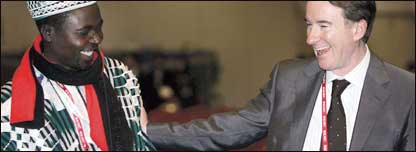


 Only home-grown solutions for our problems and the policy space to develop our own holistic development strategy without outside influence will suffice.
 SUBSCRIBE: With the sharpest writing and the finest photography, a Focus on Africa magazine subscription will keep you abreast of all the important developments across the continent.
