 | | | | | | | ||||||||||||||||||||||||||||||||||||||||||||||||||||||||||||||||||||||||||||||||||
| | |||||||||||||||||||||||||||||||||||||||||||||||||||||||||||||||||||||||||||||||||||||||
Letters | ||||||||||||||||||||||||||||||||||||||||||||||||||||||||||||||||||||||||||||||||||||||||
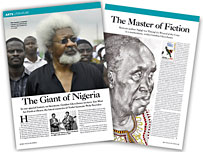
Ngugi's wisdom The column by Professor Ngũgĩ wa Thiong'o on why he writes in Gikuyu (in your October-December issue) was an inspiration to those of us who love African languages. I am a broadcaster with a Gikuyi radio station and my friends often criticise me for working for a station that broadcasts in Gikuyu. However, I am proud of my African language. It is abnormal to reject one's mother tongue and then take enormous pride in the mastery of another. This colonial abnormality has been turned into a norm in independent Africa. I agree with Ngũgĩ that colonialists associated our African languages with negativity and humiliation whereas English was associated with positive images of knowledge, intelligence and power. I feel that Africans should make use of and strengthen their languages so that people in the West speak Gikuyu, Baganda, Kinya-Rwanda, Zulu, Xhosa, Nyamwezi, Yoruba and other African languages. As Ngũgĩ says, multi-lingualism is a strength and not a weakness. An African who masters his mother tongue and then acquires other languages is more empowered. George Gatume Waweru, Nairobi, Kenya Giant of the world To give an indication of the unique place that Wole Soyinka holds in the world, we can go to no more an illustrative source than his most recent publication, You Must Set Forth At Dawn.
Wole is not just a regional giant but also a universal giant. All young literati are captivated by his brilliance and impeccable sense of socio-political chronology. He has never failed to overawe with the sharpness of his wit. To him, literature and artistic works are not just marginal but central activities in the process of human development. Let us therefore not call Wole "The Giant of Nigeria", as you did in your headline, but "The Giant of the World". Tunde Olaoye, Lagos, Nigeria Was Soyinka wrong? I was under the impression that a memoir reflects factual experiences until I read the extract from Wole Soyinka's You Must Set Forth At Dawn in Focus on Africa magazine. In the extract, the author paints a rather uncomplimentary picture of me as having "collapsed" in his company after I had clutched in vain at his throat for support, (apparently) "overcome by waves of dizziness", whereupon I had to be "resuscitated". I wish to state categorically that no such event ever occurred and I have wondered in vain why it was recorded in his memoirs. Incidentally, I am not the first prominent Nigerian to have publicly questioned the truth of some of the contents of Soyinka's latest book, although I appreciate the fact that a work of such scope and depth may contain some pardonable errors. Arthur Nwankwo, Enugu, Nigeria Political opportunists Reading your article on former Nigerian military ruler Ibrahim Babangida, I couldn't fail to notice the filth surrounding his campaign billboard: a decrepit bridge to the right of the billboard and a burdened food seller carrying a heavy load on her head and a baby on her back.
Many politicians in Africa conveniently forget about the extreme poverty and desperation surrounding them when spending huge sums of money on election campaigns to win power. What often disturbs me is that instead of spelling out a concrete vision, policies and programmes to deal with the myriad problems confronting their people, politicians entice poor voters with cheap gifts and empty promises that they often fail to fulfil when voted into office. I wish to urge the media in Nigeria to push all aspiring candidates for the 2007 elections to spell out their policies on issues such as unemployment, poverty, corruption and crime. The media owe it to Nigerians to set the agenda for an issues-based campaign that will help the electorate make informed choices. Kwaku Antwi-Boasiako, Accra, Ghana Babangida's legacy I disagree with your correspondent Sola Odunfa's statement that Nigerians are divided over Ibrahim Babangida's candidacy. All Nigerians believe his rule was synonymous with corruption, cronyism and greed. During his misrule there was a very thin line between the national treasury and the personal bank accounts of officials. IBB's "stupendous wealth", as Odunfa puts it, has never been used to create thriving economic activity in Nigeria, rather it has been used to oil a machinery of lackeys and cronies who have fallen into political and economic irrelevance and crave a return to their ignoble glory days. It's such a pity that with a population of 130 million, vast resources and a literacy rate that is the highest in sub-Saharan Africa, Nigerians still have to scrape the 'bottom of the barrel' to find a leadership that can best be described as mediocre and self-serving. Laja Fowokan, Lagos, Nigeria Praising Annan
The article about Kofi Annan in your last issue was refreshing. His impact and contribution to world peace as United Nations secretary-general will not be forgotten in a hurry and it reminds us of what can be achieved by dialogue – a weapon of peace not yet discovered by warmongers. African leaders should start walking in his footsteps. If they were humble enough to do this, ten years would be enough time within which to transform Africa. John Achile Yusuf, Abuja, Nigeria This is a small selection of letters published in the January - March 2007 edition of Focus on Africa magazine. Write to 'Letters', BBC Focus on Africa magazine, Bush House, PO Box 76, Strand, London, WC2B 4PH. Or email us at |
LOCAL LINKS  Subscribe Subscribe25 August, 2005 | News | |||||||||||||||||||||||||||||||||||||||||||||||||||||||||||||||||||||||||||||||||||||||
| ||||||||||||||||||||||||||||||||||||||||||||||||||||||||||||||||||||||||||||||||||||||||
| ||||||||||||||||||||||||||||||||||||||||||||||||||||||||||||||||||||||||||||||||||||||||






 To him, literature and artistic works are not just marginal but central activities in the process of human development.


