
Fespaco 2009, 25th February
End of Section
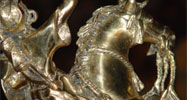
The highlight of Fespaco has always been The Stallion of Yennenga - the grand prize for the best film.
The story of Yennenga dates back to the beginning of the 12th century in the Mossi's Dagomba Kingdom, in what is now northern Ghana. Its capital was Gambaga.
Dagomba was a wealthy state, and its prosperity attracted the attention of many neighbouring peoples - especially the Malinkes, who lived further south.
Brave Warrior
The soldiers of Dagomba's king, Nedega, were brave and almost always won in any show of force.
Nedega's daughter, Yennenga, always helped him win the battles; she was not only beautiful, but an extraordinary horse-woman, and adept at using javelins, spears and bows.
Yennenga was so precious to her people that her father refused to let her marry - a decision which dismayed her.
However, she felt she could not complain to her father directly. So she planted a field with wheat.
In a few months, the crop grew - but Yennenga let it rot. She would not harvest it.
Her father was very surprised and asked her for an explanation. "You see father", she said, "you are letting me rot like the wheat in this field".
The escape
King Nedega was very upset and ordered that she be locked up. But Yennenga had friends among the King's guards.
One night, one of the king's horsemen helped her escape from the prison. Both rode long into the night and were later attacked by Malinkes warriors.
Although they fought them off, the guard was killed, and Yennenga was alone in the middle of the forest.
She bravely decided to ride further north. At one point in the journey she had to cross a fast-flowing river.
Although nearly swept away by the strong currents, her horse managed to negotiate it and took her to the other side.
Exhausted, Yennenga lay on the back of her horse - when she saw a house. It belonged to Riale, a famous elephant hunter.
The two soon fell in love, and in time they had a son who came to be called Ouedraogo - a name in common use in modern Burkina Faso.
Legacy
It is shared by one of Burkina Faso's most celebrated film makers, Idrissa Ouedraogo, who won the Yennenga prize in 1991 with a film called "Tilai".
Yennenga is also known as the mother of the Mossi people.
Today in Ouagadougou where the current king of the Mossi lives, one can see Yennenga's statues at many places. A square and an avenue are also named after the lady warrior.
End of Section

