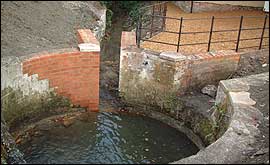
Click here to view our gallery of images showing the sheep wash pool during it's restoration and eventual official reopening. (Pictures courtesy of Bill Palmer) Click here to view our gallery of images showing the sheep wash pool during it's restoration and eventual official reopening. (Pictures courtesy of Bill Palmer)
After filling in all the relevant forms the Village Hall Committee, who undertook to coordinate the project, received a grant of £20,000 from the Local Heritage Initiative Fundto help restore Little Cheverell's sheep washing pool. 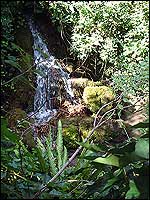 | | Sheepwash before restoration. |
Despite the pool's history having been lost in the mists of time, villagers were quick to recognise its historical importance. George Hockley of Glebe Farmhouse, Little Cheverell said: "As a small village, with a long history in the farming community, we felt that the sheep washing pool scheme has been an important historic investment for the village." To qualify for the money, the project had to be started, supported and carried out by people from the village and it also needed to involve new skills and offer a lasting way of sharing local heritage.

We felt that future generations would not thank us for letting their heritage disappear through neglect.
| | George Hockley, Glebe Farmhouse, Little Cheverell. |
Villagers focused their attention on their sheepwash pool as a piece of working history, which sadly had fallen into disrepair. As well as restoring the pool, their aim was to construct a viewing platform, so that the sheepwash could be seen safely while at the same time providing a convivial communal area. During the last few months, villagers have been lending a hand, clearing vegetation and creating the area from which the historic pool can been viewed. Bill Palmer, from Low Road in the village said: "We'd like to receive some feedback about the history [of the sheepwash], which is sadly lacking at the present. "There is much speculation and some stories about how it was built and used, but we haven't managed to trace any really significant documented facts." 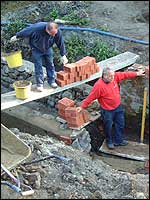 | | Restoration work continues. |
Lottery advisor Chris Burke said of the Little Cheverell project: "The project is very much in keeping with the LHI's underlying principle: that the long-term future of our heritage lies in the hands of those who value it at a local level." George Hcokley says that it's hoped the village will have been so enthused by the project that they will want to undertake the clearance of a nearby carriage ford and a few of Little Cheverell's 'dipping' wells.  Click here to listen to audio feature broadcast on BBC Radio Wiltshire about Little Cheverell's sheep wash pool. Click here to listen to audio feature broadcast on BBC Radio Wiltshire about Little Cheverell's sheep wash pool.
Click here to view our gallery of images showing the sheep wash pool during it's restoration, and its official reopening. (Pictures courtesy of Bill Palmer) Click here to view our gallery of images showing the sheep wash pool restoration in progress (Pictures courtesy of Bill Palmer) Add your comment - can you shed any extra light on these sheep washing pools and their history? What about your thoughts on spending Lotto money on this kind of initiative? James Donaldson
SHEEP WASHING IN AUSTRALIA IN THE NINETEENTH CENTURY WAS INFLUENCED BY THE SAXONY SHEEP IN GERMANY WHICH WERE WASHED AND BY THE SPANISH PRACTICE OF WASHING THE WOOL AFTER SHEARING. THERE WERE THREE MAIN REASONS FOR THE HABIT IN AUSTRALIA. 1) THE ENGLISH MANUFACTURERS AFTER 1820 DEMANDED THAT AUSTRALIAN WOOLGROWERS GIVE CLOSER ATTENTION TO THEIR FLEECES AND THE CONDITION OF THEIR WOOLS AND THAT THEY BE FREE FROM VEGETABLE MATTER,BURRS,SOIL ETC.
2)THE FLEECES FILLED WITH SAND AND VEGETABLE MATTER, BURRS ETC. WERE HARD TO SHEAR AND DEMANDED THAT THE METAL BLADES SHEARS BE SHARPENED MORE OFTEN, AND REPLACED MORE OFTEN. 3) WOOL IN AUSTRALIA WAS CARTED BY BULLOCK TEAM OR HORSE TEAMS AND CHARGED BY WEIGHT.WASHED WOOL WAS LIGHTER AND DID NOT COST AS MUCH.
THE PRACTICE OF WASHING THE WOOL RATHER THAN THE SHEEP DERIVED FROM THE FACT THAT HOTTER WATER COULD BE USED TO WASH THE WOOL,THAN TO WASH THE SHEEP.CARE WAS NEEDED TO AVOID FELTING BY USING TOO HOT A WATER.
WHEN THE PRACTICE OF SELLING WOOL IN THE GREASE OCCURRED IN THE 1890'S WOOL WASHING AND SCOURING BECAME OBSOLETE. HOPE THIS IS A HELP.JIM DONALDSON Geoff Tann, Lindsey Archaeological Services
A Victorian illustration, showing how a sheep washing pool was used, is reproduced in C.A. Jewell (ed.) 1975 Victorian Farming: A Sourcebook, which was taken from The Book of the Farm (1876)by H. Stephens. The unwashed sheep was moved upstream in the dammed pool, being rewashed in cleaner water before being released up the least steep slope. Sally Hunter
I used to live at Bridge House, Little Cheverell, and it is wonderful to hear news of the village over the web here in rural Australia. daniel parkyn
used to live on westbury road am 22 now left at the age of 16 had best times of my life in cheverell, would love to hear from anyone who remembers me or knows me contact me on dannyparkyn@hotmail.com all the best to u all and what a great job u have done on the sheep wash pool michael
sureeee why not spruce the place abit
| 



 View a


 More
More