The Fovant Badges Society
The Hill Figure Homepage
The BBC is not responsible for the
content of external sites | | 
Fovant Badges:
 Located between Shaftesbury and Wilton on the A30 near Fovant. Located between Shaftesbury and Wilton on the A30 near Fovant.
Originally 20 emblems were believed to exist, today eight can be seen.
Five badges date from the 1914-18 period, three were added in early 1950 and 1970.
The badges were created by First World War soldiers camped in villages around Fovant. |
|  | | PRINT THIS PAGE | |  View a printable version of this page. View a printable version of this page. | |  |
| | Nobody knew who had created the mysterious chalk panda, or why.
The Times newspaper speculated a connection to London Zoo, but nobody came forward. The only clue: the letters UCNW carved underneath. Did the panda represent the Union for Conservation of Nature and Wildlife?
Thirty years on, BBC Wiltshire can lay the mystery to rest.
The story begins a week before the panda's appearance. A student from Salisbury studying at the University College of North Wales has an idea. That night at the Student Union Bar he rounds up volunteers for his rag week scheme.
A week later a dozen recruits meet up at a Salisbury pub. At midnight they hit the hill with spades and a grid plan. For 6 hours they work in darkness. A 55-foot outline is cut and the turf stripped away to expose the underlying chalk. In the early hours of Sunday morning, passers-by gape at the 2,200-foot square hill figure.
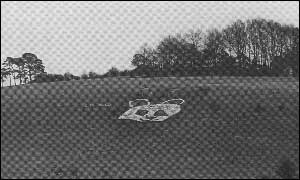
The Laverstock Panda, the symbol of the UCNW rag week, had been created.
The following year the figure was re-cut, but to no avail. Today the Laverstock Panda is overgrown and no longer visible.
It's a problem that's facing many hill figures in the Wiltshire area. The Fovant Badges are facing the same problem. The Fovant Badges 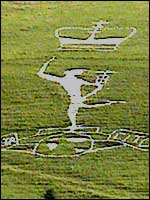 | | Royal Signals Corps badge |
The 12 huge badges were cut into the downs during the First World War. The London Rifle Brigade created the first emblem in 1914. It was stationed at a training camp near Fovant before being sent to the western front. Before embarking the men decided to cut an outline of their cap badge in the surrounding chalk hills.
Other regiments followed their example. The badges now make up the most complete group of chalk hill figures in England. The size of the badges reflects the scale of the project. The scroll of The Australian Commonwealth Military Forces emblem alone measures the length of three cricket pitches. 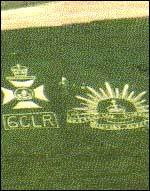 | | The scroll of the badge above measures the length of three cricket pitches |
Over the years all the badges have faded. Weeds, overgrowth, animals and subsidence have all contributed to their disappearance.
To combat the problem a restoration campaign was launched in July 2001.
Each badge will cost £35,000 to restore. A further £15,000 will be needed annually to maintain each emblem.
At the beginning of December the campaign received a National Lottery award of £70,000. The grant will enable work to begin on four of the badges this spring. Another four will be restored over the next few years.
The Lottery grant supplements the £33,000 already raised by local people. With £40,000 of charitable trust awards and a national newspaper contribution of £30,000, the total fund currently stands at over £170,000.
The Government has also decided to accept English Heritage’s recommendation to award the badges ancient monument status.
The Fovant Badge campaign however will still need an estimated £50,000 to complete the restoration programme. Can you add anymore to this story? Martyn
Was it definately 1969? As i was telling my uncle about this page yesterday and he was adamant it was 1964 as he had left school in 1965 and it was there while he went to school.. He is usually good with dates as well! Paul Davis
One further comment: "as the sky started to lighten in the east it was realised that we would not finish by dawn so the ears were reshaped to save time. They were slightly larger than planned!" Paul Davis
If I remember correctly, it was a coach load rather than a dozen and it was very hard work! Those were the days indeed Chris - I'm game for a restoration job - what about you two? Steve
Many years after the Laverstock Panda was carved, a mysterious smiley face appeared on the same hillside. Its appearance coincided with Comic Relief, and, appropriately, it sported a very fine red nose. It too has faded, but the impression of the Panda and of the similey face can still be seen on Google earth satellite photographs. Alan Crooks
The name of the UCNW ragweek was 'Panda-monium', hence the logo. I thought this was slightly more recently than 1969, i.e. the early 1980's. Derek Elsworth
I used to drive from Beckenham, Kent to Kington Magna, Dorset every Friday night in the late 60's early 70's and I remember seeing the panda and the mystery surrounding it. I have just "stumbled" across this web site across this web site and am delighted to read about this again. Many thanks
Derek Elsworth, 23 Parkside, Swarthmoor, Cumbria LA12 0HR Cllr Ian McLennan
I am the Salisbury District Councillor for Laverstock and when I first moved to Laverstock in 1981, the Panda was visible but not distinct. I looked up the history and found a picture of Panda in all its glory, in a Wiltshire Chalk figures book. I would love to see the Panda restored and wonder if any of the original folk - including the mathematics student with the grid, would come and lead the quest?
You can find me if you look at the council website and check the Laverstock councillors! Tony Gouldwell
UCNW Panda. The Rag Magazine of that year was called, "Pandamonium", hence the choice of design. The Authorities arrived at UCNW to pursue investigations, but I didn't hear of anyone being prosecuted, despite one lady professing shameless guilt.
Chris M Campbell
"My wife and I were involved in the night of intense activity led by a mathematics student who laid out a grid so that the entire creation could be done in the dark. We discovered the chalk to be too deep to dig out the entire face, so mined chalk and spread it over the white areas. There was an alert dog at the local farm who got yelled at by the owner for most of the night. Those were the days! |





 More
More