Castle Combe village website
The BBC is not responsible for the content of external websites. | 
 In 1947 the whole village was put up for auction by the Lord of the Manor. In 1947 the whole village was put up for auction by the Lord of the Manor.
Today all of the houses are in private ownership.
The village is at the southern edge of the Cotswolds, just 15 minutes from the M4, and conveniently located for Bath and Avebury.
Castle Combe has been used as the backdrop for many film and TV sets.
Inside the church is a faceless clock, a relic from the days when workers on the land only needed to hear the time struck.
| | |  | | PRINT THIS PAGE | |  View a printable version of this page. View a printable version of this page. | |  |
| | Lying within the Cotswold Area of Outstanding Natural Beauty, and generally regarded as being just too far south to be included in the true Cotswolds, even so, Castle Combe in North Wiltshire, has much in common with the renowned Cotswold towns and villages. 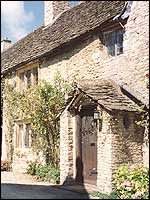 | | One of the many picturesque cottages in Castle Combe. |
Not only are the buildings built of stone quarried from the same oolite strata which extends from Gloucestershire into Wiltshire, but both share the ability to attract visitors from all over the globe, being seen to represent the quintessence of the English village.
After being part of a large estate for some hundreds of years, the lower part of the village of Castle Combe, now a Mecca for visitors, was sold by auction in 1947.
The owner of the estate took this course being unable to meet the repair costs of the properties, many of which were in a state of dereliction.
Although the National Trust attempted to acquire the entire village, (as it was successful in doing with nearby Lacock), it was finally sold in lots, a number of the cottages being purchased by workers on the estate who had occupied them as sitting tenants.
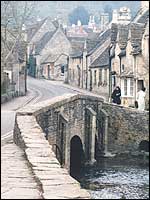 | | Castle Combe attracts visitors from all over the world. |
Prices realised were modest to say the least, many fetching between £100 and £200. The new owners soon found the upkeep of the ailing cottages prohibitive, in addition in 1960 virtually all the village buildings were scheduled as being of architectural and historic interest.
This placed a statutory responsibility on owners for maintenance of their properties, resulting in the sale of many cottages.
A steady stream of "newcomer" purchasers with the finance to repair, extend and modernise, has now completely replaced the original estate workers and their families, only one solitary individual born and bred in the lower village now remaining in residence.
continued..... |






 More
More