| WEB LINKS |  | DEFRA The BBC is not responsible for the content of external websites. | | | FACTS | | The Countryside Stewardship Scheme offers payments to farmers and land managers to improve the natural beauty and diversity of the countryside. Areas under Stewardship have seen a marked increase in previously declining bird species, including the stone curlew, cirl bunting, bittern, lapwing, reed bunting, greenfinch, pipit, twite, and wagtail. Over 1,000 miles of dry stone walls and over 9,000 miles of hedgerow have been restored, with around 16,500 miles of grass margins established. Land under agreement currently totals nearly 310,000 hectares. Since its inception as a pilot scheme in 1991, Countryside Stewardship has attracted around 14,000 agreement holders. | | | PRINT THIS PAGE | |  View a printable version of this page. View a printable version of this page. | |  |
| | 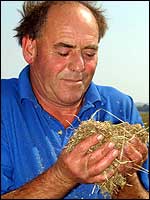 | | John Brice |
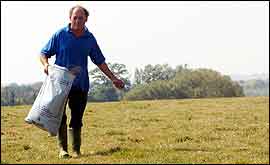
John Brice renewed his Countryside Stewardship Scheme following a successful 10 years in which he seeded seven hay fields managed for wild flowers. Defra (the Department for Environment, Food & Rural Affairs) also paid towards the planting of two hedges in order to screen the countryside from the M4. Mr Brice, who runs an 80 strong organic dairy farm and is a supplier to Yeo Valley Foods, is now working on sowing wild flowers in more of his hay fields using seeds from the first fields. This reseeding will be carried out by hand. John says: "We joined the scheme in 1993 after hearing about it from a neighbouring farmer. So far under this new agreement we have reseeded a 20 acre field and now we are reseeding a 12 acre field. It will take a while before we know how well the seed has taken, but we hope it is as successful as the previous seven fields as they are amazing." 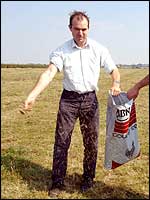 | | Rural Development Service Advisor, Charles Routh lends a hand. |
Rural Development Service Advisor, Charles Routh adds: "This is a classic example of how Countryside Stewardship is supporting the work of the farmers in conserving traditional English species of wild grasses and flowers, in species rich hay meadows. "We've lost 97% herb rich hay meadows since 1950, and this is an example of how we are trying to turn this around." Add your comment to this story |






 More
More