| Salisbury to Wilton From the city's railway station (once one of two stations) the line heads west past The Old Manor hospital building on the right... Railway Station
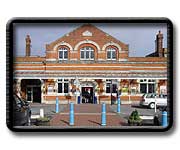 Salisbury was slow to share in Britain's railway mania and it was not until 1847 when a branch line from Southampton brought rail traffic to the city. Today's railway station lies in a former suburb of the city known as Fisherton. Once Salisbury established itself as a significant railway junction Fisherton developed rapidly and saw a fair amount of new buildings built to house those who worked on the railways. Salisbury was slow to share in Britain's railway mania and it was not until 1847 when a branch line from Southampton brought rail traffic to the city. Today's railway station lies in a former suburb of the city known as Fisherton. Once Salisbury established itself as a significant railway junction Fisherton developed rapidly and saw a fair amount of new buildings built to house those who worked on the railways. Soon afterwards the train passes the Churchfields Industrial estate on the left... Churchfields
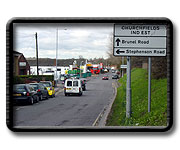 Today, where garages, builders' merchants and light industry compete for space there were once water meadows. Salisbury's five main rivers helped shape the town and influenced its economy. The water meadow system, which dates back to the late sixteenth century, allowed sheep farmers to produce grass for feed earlier in the year than normal, avoiding the need to use valuable feed stocks which could be better used later in the year. Today, where garages, builders' merchants and light industry compete for space there were once water meadows. Salisbury's five main rivers helped shape the town and influenced its economy. The water meadow system, which dates back to the late sixteenth century, allowed sheep farmers to produce grass for feed earlier in the year than normal, avoiding the need to use valuable feed stocks which could be better used later in the year. On under Skew Bridge and alongside A36 and into Wilton, with Wilton House on the left... Wilton
Wilton, in around the seventh century, was the ancient royal capital of Wessex and gave its name to Wiltshire. Following King Alfred's defeat of the Danes in 871AD a nunnery was built on the current site of Wilton House. Probably the most impressive public building in the town is T H Wyatt's ltalianate church built in 1844 for the then incumbant of Wilton House, Sydney Herbert. 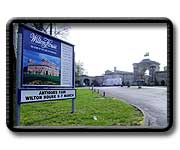 Wilton House Wilton House
Built in 1653, the Wilton House we see today is the ancestral home of the Pembroke family. The house is noted for its famous Cube Rooms and was used as a location for the film The Madness of King George. The house was visited by Churchill, Eisenhower and Montgomery ahead of the D-Day landings during World War Two.
Shortly aftewards Wilton's famous carpet factory and Outlet Village... Wilton Carpets
Apart from its stately home, Wilton is probably best known for the manufacture of carpets and the town is home to the Wilton Royal Carpet Factory, which was granted its Royal Charter in 1699. Part of the original building is now a thriving factory outlet centre. Click here for Wilton to Grovely >> | 






 More
More