According to the British Trust for Ornithology, about two million wild animals are killed on the roads of the UK every week - that's around 104 million every year. 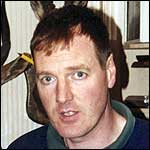
Shaun Douglas |
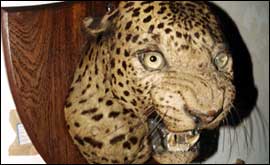
Although much of this road kill ends up as food for other wild animals, it can also end up on the taxidermist's work bench where, in the hands of skilled experts like Shaun Douglas from Salisbury, the dead animal can be 'brought back to life'. Taxidermy isn't simply about 'stuffing' an animal's carcass with straw - it's a craft which demands a great deal of practice, patience and ability. "The process of taxidermy hasn't changed greatly but the techniques and materials have changed," says Shaun. "Years ago, there were some pretty nasty chemicals - such as arsenic - used to treat a skinned animal but today we try and keep to safe chemicals," he adds. While 21st Century taxidermy uses modern materials it continues to incorporate a handful of traditional crafts including tanning, woodworking, painting and even sculpture. Looking around Shaun's workshop, you certainly get the feeling you're being watched with several pairs of beady eyes staring back at you. A leopard's head looks like the animal is about to pounce, while numerous birds stand as if frozen in time. It has to be said that Shaun's finished work is amazingly lifelike, which, when you consider the reason why, seems somewhat ironic. "The idea of taxidermy is to reproduce an animal so it looks like it is still alive," Shaun says. The only natural part of the animal used by the taxidermist is the skin (plus horns where appropriate), so you you could be forgiven for thinking you are looking at the real thing. The use of man-made materials means noses and lips are formed from wax or filler, eyelids can be created from clay and the eyes are made out of glass. Even whole bodies are manufactured - made out of Fibreglass or foam. 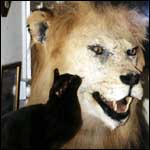
Don't get too close... you might be next! |
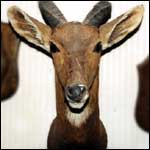
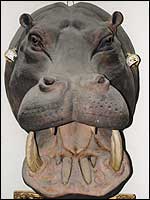
"You can write off to a company who'll provide you with the 'body' of a bear, an antelope, a moose or a coyote and two weeks later it arrives already cast for the taxidermist to then stretch a skin over," Shaun says. But once the skins are fitted and everything else is put in place the end result is most definitely a work of art - however macabre the practice might be for some. And Shaun's work hasn't stopped at animals. "I've had the odd request to do some human bits - I had a chap who wanted me to do his arm, which he had lost in a motorcycle accident, but I gave him a huge quote and needless to say he never came back to me!" Not surprisingly, Shaun's home has become a place to display his collection of mounted animals. The menagerie includes deer, fish, birds, a full-size lion, (which was put to sleep after suffering from too many fights whilst in captivity) and the head of a hippo, which grins at you as you descend the stairs. "The hippopotamus a Fibreglass specimen. It is difficult to preserve the real skin so you simply take a rubber mould from the dead hippo and fill that with Fibreglass mixed with the right skin colour," says Shaun. The result is something much more lifelike. But being so lifelike means it's tempting to believe that when darkness falls Shaun's animals come back to life only to return to their still-life positions once the sun breaks through the curtains. "It seems strange but I wish they could all come back to life," concludes Shaun, "but when they have died this is the best way of preserving their beauty." | 




 Taxidermy is a perfectly legal and respected trade which is governed by strict regulations, covered by the Wildlife and Countryside Act 1981 and C.I.T.E.S.
 View a


 More
More