Gary Dawes, from Wiltshire, bought his first pianola when he was a teenager, after seeing one on TV. Gary recalls: "It was an old, beaten up thing and was for sale for about £80; after some persuading I managed to convince my parents to let me have it." After purchasing his first machine, Gary read up on the subject, keeping a keen eye on Exchange and Mart - a good source for machines and components - as well as the pianola rolls themselves. 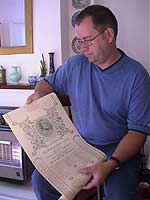
Gary Dawes |
The player-piano is quite a big machine and when Gary started his interest, many people were getting rid of them because they took up too much space or they needed refurbishing. "They can be massively heavy - some machines even contain lead piping instead of light weight rubber tubing," Gary says. The rolls are easy to collect and Gary has several hundred. "Some of the earliest ones date back to World War One and come from America - so the songs are relatively obscure," he says. Many of the rolls that Gary has collected are called 'arranged rolls', where someone worked with the original sheet music, working out where the notes had to be and how long they had to play for. "This technique produces a rather stilted 'performance', until later they developed a technique for actually 'recording' an artist playing," says Gary. A piece of paper - similar to carbon paper - was placed into the machine, which would leave behind an impression of where the notes appeared as the artist played. 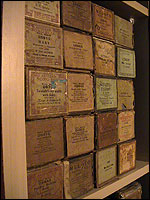
Pianola rolls |
Then someone would have to cut out the relevant holes as accurately as possible. They could then play the roll through the piano, check for any mistakes and correct the 'recording' by taping over the rogue holes and adding corrected notes by recutting the paper. From this working roll, a production master could be created, which then went on to produce duplicate rolls - a true digital reproduction of what had originally been created by the pianist. Sometimes a roll would be created by the composer of the piece themselves - which would produce an exact replication of the piece played by the musician, including every nuance and subtlety added by the composer as they played. "Before the advent of electric recordings, which saw a huge improvement in the quality of sound reproduction, disc and cylinder recordings were pretty poor," Gary says. "The pianola however reproduced the sound exactly as it was 'recorded' and so the quality lay both with the machine and the original performance," he remarks. Piano playing was a popular pastime and for those who couldn't play, the invention and subsequent development of the pianola meant that everyone could enjoy a quality performance of the current 'hit' in their front parlour. 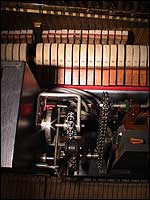
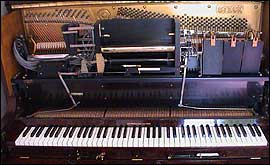
Pianola mechanism |
It would be the equivalent of having Jean Michel-Jarre performing live in your living room but without the musician having to be there at the same time! However, they weren't cheap. In 1922, a foot operated Duo-Art pianola was being sold for 275 guineas - the equivalent of £10,000 in today's money! Nowadays, there is a huge interest in collecting pianolas and the rolls associated with them. There are also several companies still manufacturing rolls, including QRS, who have been in production since about 1900. The company continues to keep up with the times, notably producing songs from Broadway shows and other contemporary performances. There are also several companies specialising in recutting old rolls - particularly those produced by the jazz greats - people like Jelly Roll Morton and Fats Waller, who were at their height in the 1920s. 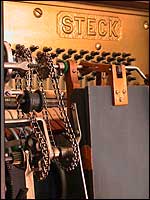
Chains and bellows of Gary's 1928 Steck pianola |
Gary has no problems keeping his machines in tip-top condition, since there are several firms providing parts and materials for pianolas. Not that a little lateral thinking is required from time to time, as Gary recalls: "I once committed the cardinal sin of replacing one of the tubes with car radiator hose because it was the same size - it worked, but the purists wouldn't approve of such improvisation!" Despite the value of pianolas in 1922, a restored machine today would cost upwards of £2000 - making it an affordable and very satisfying hobby. "I eventually sold my first pianola for £250, to a friend of my father's," Gary recalls. "Not a bad price," he adds, "considering I only paid £80.00 for it!" | 




 The first pianola was completed by Edwin Votey in a workshop in Detroit, in 1895.
  View a


 More
More