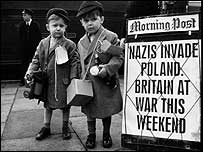
At the start of the Second World War in 1939 the British Government thought that the Germans would carry out heavy bombing attacks on cities such as Portsmouth. It was decided to send as many children as possible into the safety of small country towns away from the big cities. I was one of these "evacuees" together with my two sisters, Sheila (12) and Brenda (9). I was less than 6 years old and when I got put on the train with the other children it was the last time I would see my father until the war ended in 1945. 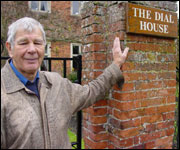 | | Keith Haines outside his old billet, Dial House, West Lavington. |
One of my billets was at West Lavington, near Devizes was at Dial House. The couple that ran it were very good to us and it had a better atmosphere than where we had been before at Bradford on Avon. The husband used to teach us boxing and even when one of the bigger kids got a lucky punch in one day and split his nose open he still kept his good humour. We used to get sixpence a week pocket money. Threepence used to go for our sweet ration, a penny for Church collection and a penny for Cubs or Scouts. The remaining penny we could spend on whatever we wanted. We used to go on trips collecting blackberries and crab apples and help to make jam with them. I remember going to Salisbury Plain (near Stonehenge) and we collected a large amount of what they called horse mushrooms, some of them as big as dinner plates. We probably lived on mushroom soup for a week. We had to take it in turn to help in the kitchen and one day I pinched what I thought was a lump of cheese, it wasn't till I stuffed it in my mouth that I realised it was a lump of yellow soap. They say crime doesn't pay. We evacuees always seemed to be at conflict with the local kids. I suppose it was just city versus country and they resented us on their "patch". Mum managed to visit me a couple of times, and I remember my brother Bert, who was in the army, coming to see me when he was passing through the area. But travel was restricted somewhat at that time, and as the other kids didn't get many visitors I didn't feel I was missing out on normal family life. There were quite a lot of army bases around Wiltshire and suddenly us kids noticed there were trucks and tanks going past the hostel all day long.  We used to stand and watch them and wonder where they were all going. I realise now it was the build-up for D-Day, the invasion of Europe. We used to stand and watch them and wonder where they were all going. I realise now it was the build-up for D-Day, the invasion of Europe.
I almost became a casualty of the build-up when a mate and myself were walking home from school one day and were both knocked over by an Army motorcycle dispatch rider. Luckily, neither the rider, nor us two kids, was badly hurt, and a bar of chocolate was our compensation. During that period of my life while I was an evacuee I probably went to 5 or 6 different schools, ranging from little village schools to schools in large towns. I suppose I was lucky in a way that I ended up with a reasonably good primary education, and while not ending up a genius, at least I did fairly well in my later years at school. When I finally went home after the war in Europe had finished I went home as a stranger to the rest of the family and it took a long time before I settled in. For five years we ceased to be a family unit and I think us younger children especially missed a lot of normal life growing up without our brothers and sisters. | 






 More
More