"Finds of flint, pottery, metal objects and coins can all tell us a great deal about the Wiltshire of days gone by," says Katie. "The main aim of my job is to reach out to people who find things, whether in their garden, whilst walking the dog or using a metal detector," says Katie, who has been appointed through the Portable Antiquities Scheme, funded by the Heritage Lottery Fund and Re:Source. 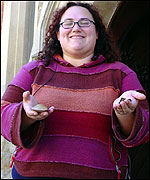 | | Katie Hinds, Finds Liaison Officer for the Portable Antiquities Scheme in Wiltshire. |
Katie has spent four years working with a team of archaeologists in Norfolk (for the Portable Antiquities Scheme and Norfolk County Council), identifying and recording thousands of objects, coins, Pottery shards and flint artefacts found by members of the public, many of whom were metal detector enthusiasts. She told BBC Wiltshire, "I think I've always been interested in the past. After university, I started volunteering for my local museum in Winchester where the scheme was just set up - back in 1999 - and I started as a volunteer there; later jobs came up around the country and I got one in Norfolk and moved over there." FACT FILE | Katie has a BA in Classical Studies and MA in Classical Archaeology,
both from Liverpool University, and specialises in Bronze Age metalwork. She will work throughout Wiltshire, including Devizes, Salisbury and Swindon, where she will be at the Museum & Art Gallery in Old Town one day each week. Katie can be contacted at Wiltshire Heritage Museum in Devizes. Tel 01380 727369. |
"We're looking for anything interesting that people dig up in their garden," Katie adds, "It doesn't have to look particularly interesting - Roman coins can appear very cruddy and horrible sometimes but we are trying to record any chance find that's made - over 300 year's old - that's our cut off point." According to Katie, a find will have more significance, if details about where it's found are recorded, together with how deep it's found and what type of location the object is in. "Bronze Age swords and rapiers are often buried on their own - and for some reason they're buried near a water source or in a river," says Katie. "And it's thought that maybe there's some kind of special link with water as to why this happens," she adds. 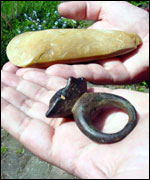 | | Found in Wiltshire: ring for holding the reigns of a Bronze Age chariot, and flint hand axe. |
Katie hopes to set up a scheme as successful as the Norfolk one, where there has been a tradition of recording finds, and working with metal detectorists in particular, since the 1970s. She is also keen to encourage people to bring in their discoveries - however trivial they might seem. "You'll be surprised - people do bring things in the whole time. A little boy brought in a Roman coin he'd found in a mole hill in his school grounds the other day, so people do find things - I mean, I don't have a very sharp eye for things, but other people do!! "There was a case in Gloucester recently where a guy found 15,000 Roman coins while he was digging his pond - so it's out there!" says Katie. Look out for more on the Portable Antiquities Scheme in BBC2 series' "Hidden Treasures" - visit the Hidden Treasure's website (details in the righthand box) and see the programme on BBC2 on Tuesday nights at 2000 BST. | 





 More
More