Experts at the cathedral have discovered that many of the timbers in the roof come from Ireland and there are more of them than at first thought. What's more, the numbers involved suggest there was a dispute with the local timber suppliers, which forced the cathedral authorities to look further a field in order to complete their thirty year building project on time! 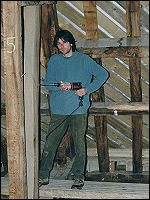 | | Using a sophisticated tree-ring dating procedure, scientists working for English Heritage have proved to the year - and even the season - when the trees were felled. |
The roofs of the eastern chapels are built from oak timber dating back to the spring of 1222 and heralding from the forests surrounding Dublin. Peter Marshall of English Heritage's Scientific Dating Service said: "The findings are among a raft of significant results to come from research commissioned for a programme of major repairs grant aided by English Heritage and the Salisbury Cathedral Trust. They will greatly increase our understanding of major historic buildings and are likely to have a profound effect on how they are repaired in future." 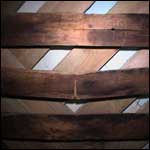 | | Batten boards |
Even the batten boards, which support the leading, date back over 700 years - surviving exposure to the weather during the civil war of the 1650s when the lead was stripped from the roof and used for musket shot. Dan Miles of the Oxford Dendrochronology Laboratory, who has undertaken the dating work for English Heritage suspected the boards' very early date. "In the past boards like this would have been disregarded because they were generally thought to be replacements for the old ones thrown out when lead was stripped. Dendrochronology is beginning to show more and more detailed information about the importance of such material," he said. 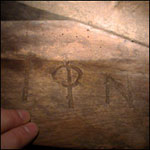 | | Analysis of the wood in the North porch roof has revealed the earliest and one of the finest crown post roofs in the country. Here and on the east chapel roofs is evidence of the earliest known use of Arabic as well as Roman numerals to mark timbers for assembly. |
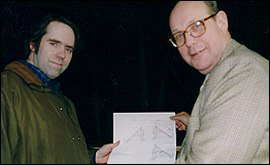
Timber for the cathedral's construction is known from documents to have come from as many as 16 different forests across Wiltshire and Hampshire as well as Herefordshire. Some trees were at least 300 years old when they were felled. One tree had a first ring date of AD 908. The dates established confirm that Salisbury, considered by many to be the epitome of Early English church architecture and the largest and most Complete 13th century masonry building in Britain, was built almost entirely to a single design. The first foundation stones were laid in AD 1220 and the whole cathedral was completed before its consecration in 1258 an astonishingly short time for such a structure. Tim Tatton Brown, consultant archaeologist to Salisbury Cathedral who has conducted extensive research into its history and initiated the dating project, said: "This very important new series of dates from dendrochronology has given us, for the first time, an independent sequence of dates for the whole of the cathedral." | | Dan Miles and Tim Tatton Brown |
| 



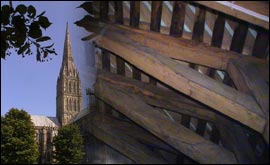


 Tree ring dating relies on matching samples of timber with master ring sequences, usually by measuring the annual growth rings.
 View a


 More
More