Stars, planets, colliding galaxies and nebula are just some of the shots taken by an amateur photographer from his back garden in Wiltshire.
And the shots are literally out of this world.
Spectacular stellar firework displays of swirling gases, ghostly fogs and drifting dust clouds snapped from literally thousands of light years away. And with sunlight taking just eight minutes to reach us, you get the idea of the distances we're talking about. If it's only eight minutes to the sun imagine where you'd end up in a thousand years.
Astrophotography
Welcome to deep space photography or astrophotography as it is known.
Astrophotography, not surprisingly, is not like taking your average family snap.
In fact it is one of the hardest forms of photography to master.
Not only have you got your lens trained on a rapidly moving object thousands of light years away but the earth's rotation means that you're constantly being shifted away from what you're trying to snap and the earth's atmosphere doesn't help.
With layers of hot and cold air jostling for position the earth's atmosphere is constantly shifting. It can make stars appear to twinkle to the naked eye. To a deep space object, magnified through a telescope, the result is an image that wobbles like a jelly. Not ideal for crisp, clear pictures.
And with distant galaxies and nebulae you've got the additional problem that you can't actually see what you're focusing on. The light they emit is just too faint to register on the human eye.
But colour film and digital cameras don't have that problem.
For self-taught astrophotographer, Philip Perkins, it's a question of what you can't see you can at least photograph:
"If your eyes were hundreds of times more sensitive you would see close to the images I produce here.
"The eye can't retain photons for long enough for us to see these objects. The difference with film or digital camera is that they can build up the photons over a period of time. They build up and build up so that over minutes or hours you can pull out of the sky wonderful things you can't see at all."
But it's not as easy as point and click.
Each final image, Philip creates, is a composite of six individual shots. And each individual shot, to capture enough photons, has a massive exposure time of up to 50 minutes.
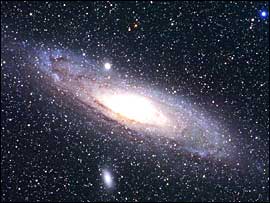
1 of 10- Andromeda Galaxy - Beyond the Milky Way
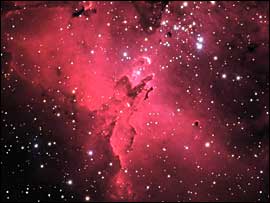
2 of 10- Eagle Nebula - Serpens
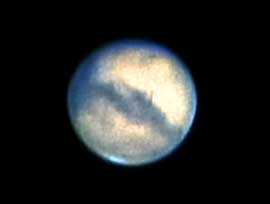
3 of 10 - Mars
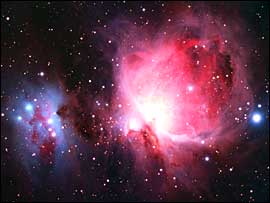
4 of 10 - Great Orion Nebula
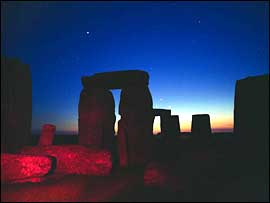
5 of 10 - Planets over Stonehenge
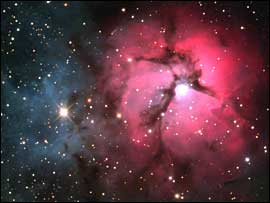
6 of 10 - Trifid Nebula - Sagittarius
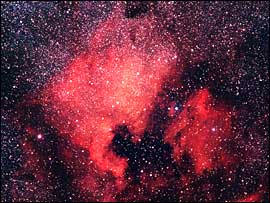
7 of 10 - North America Nebula - Cygnus
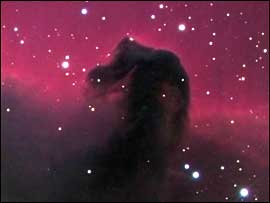
8 of 10 - Horsehead Nebula - Orion
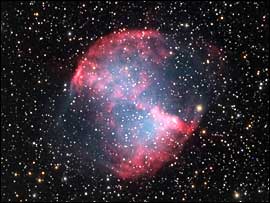
9 of 10 - Dumbbell Nebula - Vulpecula
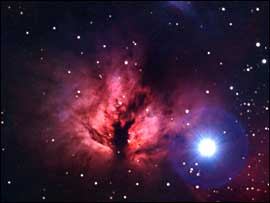
10 of 10 - Flame Nebula - Orion
But how do you focus on a speeding object in deep space, for up to five hours at a time, whilst being rapidly whisked away from it by the earth's rotation?
Simple, some heavy-duty specialist equipment or an astrophysics mount to be specific. Not only does it locate a star for you, lock on to it and track it but even rotates in sync with the earth's rotation.
Nebula
So with a telescope and specialist camera attached even if you can't see your subject you can, at least, point your lens in the right direction. Which is good to know especially when you're focussing on say a nebula:
"You know where it is but you can't see it," says Philip. "All you see is stars, a field of stars."
Invisible to the naked eye, they may be, but thankfully these beautiful objects are not camera shy.
Hundreds of light years across, and made up of dense clouds of dust and gas, they drift through the cosmos like ghostly fogs taking on intricate shapes like pictures in the clouds.
The Horsehead Nebula, in Orion, for instance looks distinctly horsehead shaped and glows with a deep red aura. Alnitak, a nearby bright young star in Orion's belt is to blame. Pumping out great lethal doses of radiation the hydrogen and oxygen gases, surrounding the nebula, literally glow like a fluorescent bulb.
"It's hundreds of light years across and just happens to be in the shape of a horse's head," says Philip. "It's actually changing quite rapidly but it's so far away we don't see the changes. It seems constant to us."
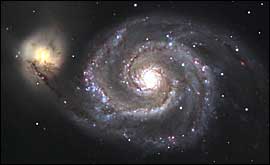
The Whirlpool Galaxy
And it's not just the nebulae close to home, in our own Milky Way Galaxy, that are within photographic reach.
In another nearby island galaxy, just 37 million light years away, Philip has caught on camera images of the photogenic Whirlpool Galaxy .
The Whirlpool Galaxy is suffering from a close encounter with a nearby companion galaxy. Over 200 million years ago they collided and the Whirlpool Galaxy, now severely distorted, is slowly being pulled apart.
But it's the surprising colour that dominates these beautiful images. From the misty electric blues radiating from the energetic, bright young stars clustered along the spiral arms of a galaxy to the reds and browns of their older, colder counterparts at the system's core.
"It's a huge adventure to be revealing things that cannot be seen at all, very significant things, that are part of our greater world."
But is there life out there?
"Oh yes, there's got to be, based on probability. The universe is so huge. It is inconceivable that there's not other life out there. In what form, I've no idea."





 View a




 More
More