To coincide with Patrick Moore's lecture appearance at Salisbury's City Hall on September 17th 2002, we asked you to send in your questions for him. James Killeen from Chippenham and Lloyd Chorley asked what we considered to be the two most interesting questions and they each won a free pair of tickets to the lecture. Your questions are as follows: John Lees from Northumberland asked: Apart from carbon, what does Sir Patrick think could form the basis of life - silicon perhaps or even water as in the film, The Abyss? Patrick: Now I think it's got to be carbon-based life. The only possible alternative is silicon and there is no evidence of silicon-based life anywhere. You can't entirely rule it out I suppose but I would go for carbon or nothing else. Eamon Hogan from Gloucestershire asks: Which of the forthcoming planned space missions excites you most? Patrick: Difficult to say. They're all so fascinating aren't they. I suppose really the Beagle mission to Mars - if we do want to find any trace of life there. If there is any trace of life on Mars it will show that life will appear where it can. Gaz Hutchinson from Somerset asks: Looking back over all the new discoveries, manned and unmanned missions and new theories since you have been involved in Astronomy, which was the most exciting for you and why? Patrick: Well the point is I am of course a Moon man, therefore I've got to say the lunar missions, the lunar exploration and the lunar landings. But of course in the wider field of Astronomy, for example the discovery of the background radiation which is going back to the Big Bang. In my own particular case I've got to say the Moon as that is my own particular subject. John Smith from Swindon asks: What do you make of all the conspiracy theories as to whether man did actually walk on the moon? Patrick: How anyone can believe that I do not know if ignorance is bliss they must be very happy! I've never heard such utter rubbish. We did a Sky ant Night programme about this a while ago it is just utterly absurd! James Killeen from Chippenham asks: Would the time it takes to send and receive each others messages mean we would find it almost impossible to have a conversation with another distant intelligent life-form? Patrick: I think that is right. The nearest stars that are like the Sun that have planets like us going around them are about 11 light years away, therefore if you send a message out you'll get a reply back many years later. You can't have quick-fire repartee that way. Steve Field from Urchfont asks: Do you think humans will ever make generational trips between star systems, or will we send proxies - androids perhaps, with banks of DNA? Patrick: Frankly I don't. I don't think the human frame will strand up to it. If we're going to reach planets and other stars there must be some fundamental breakthrough. Teleportation, time warps, space warps - that is pure science fiction now but no more science fiction than television was a few generations ago. Until that's done we're stuck here. Robert Jones from Rossendale asks: Do you ever get frustrated at the sheer immensity of space and that astronomical discoveries are relatively slow forthcoming? Patrick: No I don't think I do. I've always lived with it to an extent and after all every discovery we make now opens up a whole host of other avenues. There is so much we don't know but we are finding out more all the time. Julian Powell from Quedgeley asks: Has Star Trek had a greater impact on popular interest in space exploration than the Sky at Night? Patrick: I think science fiction on the whole has and Star Trek was very good. It's not as good as it was as they've gone all politically correct! Going back a bit now I loved Quatermass and Quatermass and the Pit - tremendous fun. Julian Powell from Quedgeley asks: Is it really worth the effort to go and see a total eclipse of the Sun? We went to Cornwall, in the rain and were impressed but not overwhelmed! Patrick: Believe me there is nothing in nature to equal the glory of a total solar eclipse. Until you've seen one you can't imagine what it's like. It really is the most amazing sight. David Williams from Leighton Buzzard asks: When you went to talk to the first men who went to the moon, what did you say to them? Patrick: Well I knew them beforehand as I was on their committee. After all they were going more or less into the unknown, the main question was, isthe lunar surface safe? Which of course it was. Divyen Shah from Harrow asks: If interstellar travel is possible, approximately how many years from now does Patrick think will it become reality? Patrick: I don't think we'll see interstellar travel until we make some sort of fundamental breakthrough. We can't do it with rockets or our material means. Perhaps a space warp, time warp, teleportation. That may happen tomorrow or it will never happen, until it does we're stuck here. John Beckett from Darlington asks: In your novel, Domes of Mars, you write about spaceships landing on Mars after months of space-travel and the astronauts building a colony on Mars. How close are we to that reality? Patrick: I think if we wanted to we could send men to Mars by around 2020. But two things may stand in the way. Firstly, the human body may be the weak link and secondly, and more importantly, do we want to do it? It depends on world leaders and our current world leaders inspire in me no confidence at all. Leon Buteaux from Welwyn Garden City asks: Is there a way of using the sun's mass and it's effect on light to see into the far reaches of space? Patrick: It's called solar sailing and in theory I'm highly skeptical. Solar sailing has been investigated and it might come in but I think not. Matt Bateman from Swindon asks: What other musical instruments can you play other than the xylophone? Patrick: Well I play the piano a lot but I wouldn't play it in public. I'm not really a performer, I'm a composer. My wretched spine trouble has put my hands out of action and I can't do anything now. Del Palmer from Wigan asks: You have been interested in astronomy for over 73 years. Is there anything relating to astronomy that you would like to do but have not done yet? Patrick: I'd love to go into space! Although I couldn't think of a rocket large enough to launch me! I think I've done most of what I'm capable of doing. I 've thoroughly enjoyed doing it. I've been involved with a big telescope, I've been involved with the moon programme and done quite a lot of research. I've done what I can. My main role now is to encourage other people, hence the Sky at Night programme. Chris Hickling from Wantage asks: If life was found on another world and you were chosen to be the representative from Earth, would you go even if they look like 'May Bugs'? Patrick: I don't like May Bugs! I can't imagine them resembling a May Bug but I'd certainly go, come what may! Russell Hutton from Clifton asks: How long till we have telescopes that can see to the beginning of the universe? Patrick: Can we see the beginning of the universe? Does it have a beginning and and end? Those are things that so far are totally beyond us. We're probing further and further, we're at more than 12,000 million miles but as for the future, I don't know. Seldiy Bate from Croydon asks: Does a planet have to have a sun to revolve around? Patrick: There is no reason why there couldn't be but I can't imagine they would be very welcoming places. A star creates energy and a planet doesn't. That's the fundamental difference. Neil Mercer from Swindon asks: How far is it possible for a radio wave to travel in space and how long would it take to reach a possibly inhabited star? Patrick: Well radio waves travel at the same speed as light. So it would depend how many light years it was away. Liz Rodgers from Torquay asks: Looking at the marvellous design of the Universe, do you believe it all came about through evolution, God or something else? Patrick: I don't know I wasn't there! There are three things I never discuss in public - football, politics and religion! Fiona Jesson from Down Ampney asks: What scientific breakthrough will be necessary for man to walk on the surface of Mars? Patrick: I think the main thing is the human body. The radiation will be dangerous and we must protect ourselves from that. You can't take chunks of lead with you. We'll have to see how we go with that. After all, men have been in space for over a year now and they're alright. John Smith from Horncastle asks: Is it possible that another life-form, far more intelligent than man has the technology to visit Earth? Patrick: Yes. After all I'm sure there are plenty of beings in the universe far more advanced than we are and that wouldn't be very difficult. They could come here. Flying saucer stories may be rubbish but I'm not saying a flying saucers couldn't come here. There is no evidence that it has ever happened but I wouldn't rule it out. Andy Barnes asks: If you were a young man today, what area of astronomy would you concentrate on? Patrick: Well of course I'm a solar system man - moon and planets so my interest will always be there. But if I were a young man again my interests might be different, perhaps astrophysical research. Lloyd Chorley from Swindon asks: What do you think the effect on society would be if alien life were discovered? Patrick: I think we'd do some very radical rethinking. It would affect our whole philosophy, our whole outlook. It would make us realise how very much we are unimportant. I very much wish it would happen. One thing I'm certain about, people say why send out radio signals in case someone comes and takes us on. Well, if any civilisation can come here they will be far wiser than we are and they will come in peace not war so I'm not worried there. | 




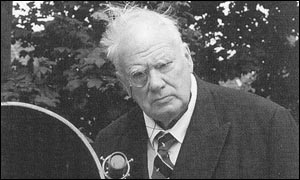
 Patrick Moore will be appearing at Salisbury City Hall on Tuesday 17th September
 View a


 More
More