

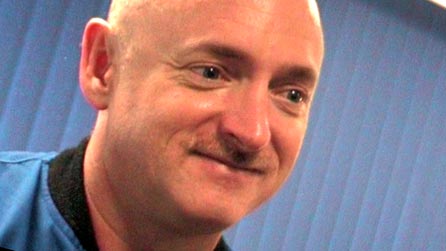
The Flight Commander of space shuttle Discovery discusses education, nutrition and the importance of teamwork.
Raise Your Game: Why did you decide to be an astronaut?
Mark Kelly: When I was younger I was very interested in the space programme. During the Apollo missions I watched some of the later moon landings. It wasn't until I became a navy pilot that I really got interested in the space programme and decided that's what I wanted to do.
RYG: What were you like in school?
MK: When I was younger, I was not the best student until I was in the 9th grade which is around 15-years-old. I started to realise how important doing well in school was, so I started to work much harder. I don't think it was one specific thing that made me want to turn it around, but it was probably my parents telling me over and over again how important it was to get a good education, and finally, at a certain age, it clicked and I did much better.
Profile
Name:
Commander Mark Kelly
Born:
21 February 1964
From:
New Jersey, USA
Job:
Flight Commander of space shuttle Discovery - May 31 2008 to June 14 2008
RYG: What qualifications do you need to become an astronaut?
MK: The astronaut office in NASA has about 80 people in it; half of them military based and half civilian based. Each person has a different background and a different degree. On the civilian side there are engineers, scientists, some medical doctors, even a veterinarian. Then there are military people like myself. Navy test pilots, air force test pilots and Marine Corps test pilots, etc.
RYG: Why is it important for young people to learn science and maths?
MK: Science and maths are really important to the space programme in the United States as well as here in the UK. Every year both of our countries are graduating less and less scientists and engineers, and that's a big problem. So it's important that we encourage kids in school to study maths, science and engineering so they can go into those fields when they graduate.
RYG: How long does it take to prepare for a mission?
MK: For a crew member it takes about 12 to 18 months to prepare. That's after the people that make up that crew have been in the astronaut office for a number of years and have had a certain amount of training. Then we come together and we begin to prepare as a team.
RYG: Do you have to be physically fit to go into space?
MK: The fitness aspect of it is important and we do work on that to some extent, but really it's teamwork and understanding how the space shuttle works that takes priority. We spend a lot of time with space shuttle systems, practicing normal procedures and emergency procedures. It's kind of a long process.
RYG: Why is it important, not just for astronauts, but for everyone, to keep themselves physically fit?
MK: I think physical fitness is important as an aspect of everyone's life. It's good for your health and it's good for your mind. It allows you to process at a higher level and do things that are more complicated.
RYG: How important is it for you to have the right food when you're in space?
MK: We have dieticians that make up a menu for every space mission, whether it's a space shuttle mission or a space station mission. They spend a lot of time making sure we have very nutritionally balanced meals. For us it was only two weeks, but for some people they can spend up to six months in space.
RYG: How important is teamwork in space?
MK: A space shuttle crew is a team of seven people. It is important that we can work together effectively as a team. It's not a group of individuals; a group of seven people working together will work better than seven individuals. We practice this thing called crew co-ordination and crew resource management which is how to maximise the effectiveness of our team.
RYG: What kind of advice would you give to someone looking to follow in your footsteps?
MK: The space programme is an exciting job. They're very exciting careers and someone wanting to be an astronaut should aim to do really well in math and science or go into the military and become a pilot. If you work hard, there really are a lot of opportunities out there for you.
See also
Elsewhere on the BBC
Elsewhere on the web
Latest
The failure is in not trying at all.
City of Cardiff Swimming Club Coach
Training ground

Work hard
Colin Jackson reveals more top tips on making exercise part of your lifestyle.