


- Prioritise using performance profiling: identify desirable characteristics which will help you to achieve your goals and rate yourself on a scale of 1-10 on each. This will help you to identify which areas need the most work - a good starting point.
- Don't overwhelm yourself: focus on a few areas at a time.
- Set measurable and specific targets: if you're dealing with abstract concepts, such as confidence, rate yourself on a scale of 1-10 and decide where on the scale you'd like to be. Think about what would make that difference, and be specific, e.g. in which situations do you feel like you're lacking in confidence?
Raise Your Game: What does your role in sports psychology entail?
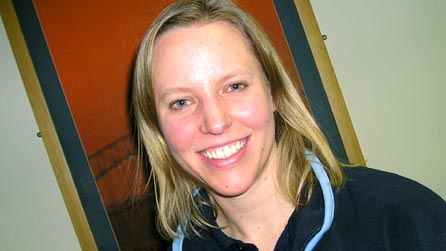
Joy Bringer: Here at the Sports Council, I work with elite athletes and help them perform to a higher level. It's mostly teaching them mental skills. For example, I help the athletes become aware of what motivates them. To a certain extent it's very individual, so what works for one person may not work for another. It might also be helping them look at their lifestyle in general.
RYG: What sort of athletes do you work with?
JB: I work with a range of sports. Last year I worked with athletes across 10 or 15 different sports, including disability sports. I went to the Paralympics this year and worked with athletics - a sprinter, a discus thrower and shot putter - and power lifting and judo. I also work with able-bodied sports: tennis, golf, athletics, gymnastics, even weight lifting and shooting occasionally.
RYG: Do you need to know about the sport?
JB: I think ideally it helps to know about the sport - you can often identify things as a result which will help the athletes to improve. However, there's also an advantage to not knowing too much because you can sometimes overlook things because you're so closely involved. You can ask what might seem like a daft question, but it might actually challenge someone's preconception about the sport or about their situation. It might make them step back and think about it in a different way.
If I don't know a sport very well I try to go out and watch the athletes in training or competitions and find out as much as I can. The perspective I take is that the athletes and coaches are the experts in their field and I'm the expert in sports psychology and we work together as a team to find a system which will work best for the athlete.
RYG: So there's lots of team work which goes on behind the scenes?
JB: Yes. There's also teamwork in individual sports. When an athlete stands on the starting line to run a race, it's not just them on their own; there are a lot of people who've been involved to help get them there.
I don't like to take credit for it because it's the athletes who've done the work. I like to think I nudged them in the right direction or asked questions to make them think and reflect but I prefer to give the athletes credit.
RYG: Can you give us some goal setting pointers?
JB: One process that we use to help athletes set goals and priorities is called performance profiling. We will get them to identify characteristics of elite athletes or characteristics that are important to them in reaching their goals and to rate themselves on a scale of 1 to 10 for each.
I'll have the coach rate the athlete on the same characteristics, and you'll often see discrepancies. I can do this in Excel and have the computer draw a graph so you can visually see the differences. Then I can sit down with the coaches and athletes and discuss those immediately. I find that very useful for coaching athletes who are visual learners.
It's important to set measurable targets. In strengthening, for example, the athlete can say 'By the end of the month, I want to increase the amount of weight that I'm lifting,' so you have a very specific goal which is easy to measure.
In sports psychology it's more difficult because the key skills we're talking about are motivation, attitude, concentration and confidence which are hard to measure. I'll encourage the athletes and coaches to put a number on those things.
For instance, you might rate yourself as a 7 out of 10 on concentration. We'll talk about what that 7 means, and what it would take to move from a 7 to an 8. It's really important to talk about what that 8 actually means too. You take a concept which is really abstract and make it concrete by assigning a number.
I'll also get them to break down the characteristics and be specific. It might be that they need more concentration before the point starts or that they lose concentration after they've lost a point.
If you were an elite tennis player, you might look at a number of characteristics that you need to improve on to make it to the next level: your serve, your ground strokes, your concentration, making sure you're committed, etc.
If we broke those down a bit further and rated each area you might find that you and your coach agree that you're an 8 out of 10 on most of those areas, but maybe on confidence you're a 5 out of 10, so very quickly we see a gap of 5 there. On the others, you only have to improve by 2, so that rating system helps us to prioritise the areas to work on.
RYG: In what other ways can you help athletes improve their performance?
Joy Bringer
"Sometimes we take for granted in our everyday conversation that the other person understands what we mean."
"Sometimes it's helpful to have someone from the outside step in and make some suggestions about improving the 2-way communication and try to get decisions to be made together."
Athletes usually come to me about reducing anxiety or working on their concentration or that kind of thing. If they're trying to improve their game, communication is an area which sometimes comes up. It might be something that they're not aware of until we start to talk about it. It might be communication with their coach or other players if you're dealing with a team sport.
One of the things I've done to enhance coach-athlete communication in the past is to get them to be very specific and clarify what they mean when they say certain words. In tennis, for example, if the coach is looking at the player's serve and they say it's not powerful enough, we need to break that down and look at what it actually means. It might mean something different to the athlete than it does to the coach.
I've helped athletes communicate better with their coaches and helped the coaches to be more open to listening to the athletes. That's something that some athletes and coaches find difficult if they've been working together for a long time because there's a lot that's assumed between the two of them.
If they started working with the coach when they were 12 or 13-years-old they would have needed a lot of direction, but as they grow older, the athlete may want more independence or more say in what they're doing. That will require the coach to change their style to adapt to the growing needs of the athlete. When you're involved in that on a day to day basis it's quite difficult to realise that that needs to happen.
See also
Elsewhere on the BBC
Latest
It doesn't matter what game it is, I just try and do my best.
Wales and Llanelli Scarlets rugby player
Training ground

Work hard
Colin Jackson reveals more top tips on making exercise part of your lifestyle.



Joy Bringer
"It would be overwhelming to focus on 30 things at once, but if we focus on a few areas, we're likely to be successful."