

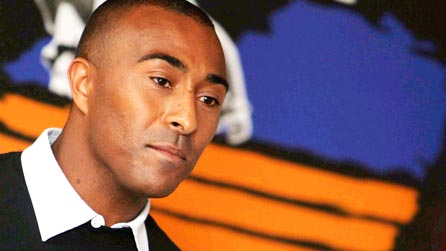
Raise Your Game: How do you pace yourself when you're running?
Colin Jackson: When we were 'distance running' (Paula Radcliffe would laugh at me when I call it distance running!) we used to use maths, in a way, to work out how to be as energy efficient as possible - that's what we aim for.
When you are running 300m in 37 seconds, if you can use less strides to get round then that is what we try to do. We count and work out that we need to use 27 strides to get round the whole thing in 37 seconds, which would be good.
You're pacing yourself the whole way through. The same applies when running for 39 seconds - you still want to be energy efficient. That means, if you want to have the same stride length, because you're running a little bit slower then you've got to learn to lift your knees a little bit higher.
We use maths in distances, measuring hurdles out. When it's very cold in winter time, you bring the hurdles in a bit to make it a little bit easier for you to make your distance. The first hurdle always stays on the mark, the second hurdle you bring in 1 foot, the third hurdle you bring in 2 feet, and so on. In that sense, I use maths to keep the distances equal all the way through.
Then you want to force your leg speed at the end, so you jump one foot and bring it in 2 feet. This makes the speed of your running so much faster because you cut the distance that you are running down whilst you're running at your fastest which increases leg speed too.
You have to be very accurate otherwise you will run into trouble, literally! You don't want to run into a barrier at 30 mph! This has to be right, it's very crucial. One mistake and you're injured.
RYG: Any tips for pushing yourself that little bit further?
CJ: I remember when I used to do push-ups and we had to do 30 seconds worth of push-ups in a circuit, and I would always do 42. If I could reach 45 in that 30 seconds, then I knew that I'd pushed myself just over that limit, because you would be working flat out anyway.
When I was going up and down with push-ups that's when I'd use maths, to work things out and understand how much effort I was using, and whether I was slacking. If I only did 40, that meant I wasn't working as hard as I should have been! If I was working flat out and I couldn't squeeze anything more out of myself, that should be my minimum, always.
RYG: Did you follow other people's stats?
CJ: I was quite obsessed with statistics, I still am to be honest, and what was most interesting was looking at where you could get improvement. When I look at when I broke the world record, my timing between hurdles one and two was 1.03 seconds - that's what it took me to cover the nine metres from barrier to barrier.
What we constantly tried to do after that, was to get that time down, because, at the back of the race and the middle bit when you are running your fastest, I was at 0.98 seconds. When you have statistics like that it helps, plus I've got these statistics for all my major rivals: Roger Kingdom, Mark McCoy and Allen Johnson. I could actually see at which stage of the race they were at their quickest.
I could go back and see that I need to be stronger at this point, more accurate at this point, not make a mistake at this point because these guys will always be on my back at this point. Once you have those statistics you can use them in the right way so that it is a huge advantage. That's why I had such pleasure in stats.
Profile
Name:
Colin Jackson
Event:
110m Hurdles
Achievements:
- World record holder 60 & 110m hurdles
- Major championship medals: 23 (13 gold, 9 silver, 1 bronze)
RYG: How else does this knowledge help you?
CJ: It fills you with confidence. If you are running in a race, neck-and-neck with somebody and you know that they are going to die at this next hurdle, you just know 100% that you are quicker than them at the back end of a race.
It can work in the opposite way though. If someone who is stronger or quicker than you is standing next to you, then you really have to focus and think that perhaps today is the day when you produce that magical last 20 metres.
RYG: And this is something you can think about over a 12 second race?
CJ: Oh yes, definitely! You'd be very surprised about how much you can think about between barriers and decisions that you can go through and make.
RYG: Do coaches keep statistics too, or is it more of a personal thing?
CJ: My coach, Malcolm Arnold, wouldn't have kept specific statistics, but we would always have access to them. We were very fortunate that we had the opportunity to work with sport scientists. They loved the fact that they could work with us because it would give them a bench-mark of world class athletics.
If Malcolm really felt that there was something very specific that we needed to work on then we would go and refer to these statistics.
RYG: Have statistics improved over the years?
CJ: There are now more sports scientists, more people interested in the dynamics of every event and they are always thinking of the best ways to get you to be at your ultimate.
Virtually every centre of excellence will have a sports scientist based there and their job is to serve the athletes and give them as much information about themselves as they possibly can. It's one of the few things they can do these days that is legal!
See also
Latest
There's no reason you can't achieve what you set out to.
Olympic gold medal winning cyclist
Training ground

Work hard
Colin Jackson reveals more top tips on making exercise part of your lifestyle.