
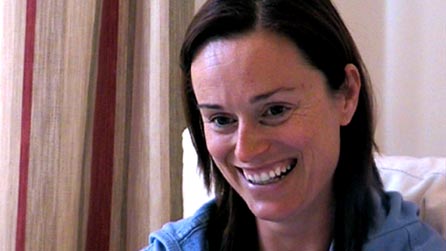
How can you improve your posture? Does eating at night make you put on more weight? Fitness expert and extreme race and endurance runner, Molly Melhuish, answers these questions and shares her tips on staying in shape.
Step it up!
- Use a step counter. When you clip one of these on your pocket or belt, you'll have more incentive to move around when waiting for a meeting, watching kids, at the mall, shopping for groceries, etc.
- During the first week, just count. Use your first week as an average and then try to increase the daily count by 1,000 additional steps during the second week, etc.
- Most of my ecoach clients who have done this, tend to have a starting average between 3,000 and 4,000 steps. By moving up to 10,000 a day (in 10-12 weeks) you have the opportunity to burn 20 or more pounds a year.
- An accurate step counter can cost between £2 and £20.
How to walk briskly
- A 90 degree bend in your arm makes your arms a shorter pendulum, so they can swing faster as your step speeds up. At normal speed allow your arms to swing freely and rhythmically, remembering that your arm speed controls your leg speed.
- Quicker, smaller steps will cover more ground, then long strides, which tire your muscles. Resist the temptation to lengthen your stride to go faster. Strike the floor with the heel of your shoe, roll onto the ball of your foot and aim to push off with your toes.
- Avoid bending over and looking down on the floor. Stay tall with your head up, checking for obstacles that are in your path.
- Control your breathing - take full breaths and exhale completely.
- When walking uphill, take smaller strides, leaning into the hill. If the hill is really steep, traverse (zig zag) up it to make it easier on your legs.
Park and walk
- Whenever you have an errand, park your car as far away as you can handle and walk to the store. At the mall, park at the farthest end and walk the length of the mall. Use every opportunity to walk. At the end of the day, it all adds up to better fitness.
Stairs
- To add strength to leg muscles and get a cardiovascular workout at the same time, try climbing plain old stairs. This can be done at home, in your office, apartment building or on stair-climbing machines in the gym. Climbing two steps at a time is good for building the quadriceps (thigh muscles) and the gluteus (butt). Going down steps builds strength in the quadriceps and to a lesser extent, the hamstrings.
Keep hydrated
- Water not only fills you up and lessens your appetite, it prevents those "hungry horrors" we all encounter when our blood sugar drops and we reach for cookies, candy, ice cream, fries or other high-calorie treats. Water also flushes out the system, rids the body of bloat and toxins and rosies up the complexion. Now start splashing!
- Start out with two quart bottles in the morning and carry one with you to work or wherever you go.
- If you like, divvy up the 64 ounces of water into eight (8-ounce) bottles or four pint (16-ounce) bottles to carry around with you all day. Freeze half of them the night before and they will last all day, even in a hot car. Keep some unfrozen so they will be ready to drink immediately.
- Yes, you will have to make more frequent bathroom trips, but it is worth it. Drink your 64 ounces of water before dinner if possible, so you're not up half the night going to the bathroom.
Six easy steps on finding a gym
- Do the gym staff have some academic and life-experience education regarding weight training? If they don't have a sports medicine or exercise science degree, they should at least have some sort of certification from a recognised organisation such as the National Strength and Conditioning Association.
- Is the gym clean and is the equipment well maintained? Check the seats on benches and machines and make sure they are stable. Make sure the cables do not appear worn and are likely to break.
- Is the air in a gym fresh and well circulated? It should never smell stale or musty.
- Is the temperature of the gym maintained at a level that won't increase the possibility of injuries? Temperatures that are too cold make joint and muscle injuries more likely.
- Does the gym you're considering have any regularly scheduled follow-up evaluations of your progress? It's essential to find out if they offer an initial orientation to equipment you don't know how to use, but it's also vital that they schedule times to reevaluate your program and vary the routine.
- Does the gym have an emergency medical plan in place and are the staff members trained in CPR and first aid in case someone becomes ill or injured?
Simple tips to success
- Use physical activity as a reward.
- Dig the garden - it's free, it burns off calories and you can even start to grow your own fruit and veg.
- When stretching quads - hold ear for balance.
- Do 50 calf raises every time you clean your teeth.
- Improve your posture by answering the phone standing up and switch hands.
- Do crunches in bed before you even get up in the morning. Do 10 stomach crunches while lying flat on your mattress and increase the amount of stomach crunches daily by one until you get up to a number you are satisfied with. Don't be shy. Try it!
See also
- Molly Melhuish tells us why she decided to run the Marathon Des Sables.
- Molly Melhuish explains why preparation is so important in the run up to a tough race.
- Molly Melhuish talks about how it feels to complete the Marathon Des Sables.
- Marathon Des Sables image gallery.
- Sam Murphy - the author and fitness guru shares her tips on staying fit.
Elsewhere on the BBC
Latest
It's all about attitude, being dedicated and committed to what you do.
Olympic bronze medallist swimmer
Training ground
Work hard
Colin Jackson reveals more top tips on making exercise part of your lifestyle.