

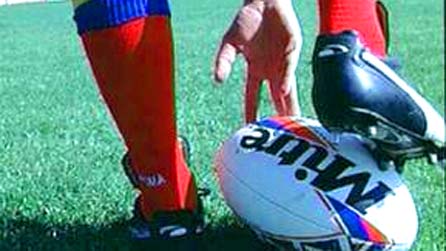
The international rugby referee likes to keep a level head and keep his feet on the ground.
Raise Your Game: Tell us the main problems you face as a referee today. Have they changed from when you started out?
Nigel Owens: I started in the late 1980s and it certainly has changed in the last 10 years. Refs are under a lot more pressure as rugby is televised, there is the qualification for Europe, and it's now a living for players.
I see more verbal hatred of referees now than there was 10 years ago, it's certainly more hostile. It's no longer traditional rugby supporters who go to games. It's treated more like an event now.
Some people go to rugby matches who have never been before, they are not the traditional rugby supporters that you have your good humour banter with. They are there for the occasion, they get drunk and you can have beer thrown at you.
RYG: How much time do you have to spend studying the laws of the game?
Profile
Name:
Nigel Owens
Born:
18 June 1971
From:
Pontyberem, Wales
Game:
Rugby Union referee
Achievements:
The only Welsh referee to officiate at the French Rugby World Cup 2007.
NO: You never stop studying the laws of the game. I put by a couple of hours every week. I always skip through my law book, maybe I have refereed a game and I want to look something up, or I have seen a game on TV and thought something in particular to be interesting and I want to know more about that.
It's essential to understand the laws of the game inside out. As a full-time referee it's an essential part of my workload in the week. It's part of my job to be aware of the laws that change.
RYG: How does a referee get bullied? Does it happen on and off the pitch?
NO: It certainly does, and it's probably worse when you're starting off. Because you're a young and new referee sadly people try and take advantage. In the environment you are in at lower level there are no stewards, whereas at the higher level you have the security of the stewards, and health and safety...
From my point of view, the crowd try and influence you as do the players on the field, but the bullying at the top level of rugby isn't such a problem.
At lower level when you start off with junior and school matches with parents watching games, it can be quite intimidating. You're walking off the pitch and the ground isn't enclosured off properly and spectators are on the touch line and you can get the sense of being bullied as a referee. Obviously at higher level, ground safety requires you look after the officials, so it's less of a problem at the top.
RYG: Does the camera encourage some players to act up?
NO: Yes definitely. They will try and influence the referee's decision and especially if they know the camera is watching them, they certainly do act up. The camera puts pressure on you as a referee too, but in other aspects of the game the camera can make it a better game.
RYG: Does the threat of citing/legal procedures after games prevent players from random acts of violence?
NO: No doubt the game is much cleaner now. It's now a player's living and if you're not playing or you get banned from a certain amount of games then you have a loss of wages and you can't afford to do that, as in any industry or any work you do.
The fact the games are on TV, and the fact that there are touch judges who can act on foul play in conjunction with the referee is a good thing. Certainly the citing procedure has cleaned the game up.
The game is quicker now than it used to be, so there is not much time for the thuggery and mucking about. Alternatively, if cameras and citing don't exist like at lower levels, unfortunately bullying and intimidation can remain a problem.
RYG: Do you think some of the problems with young people and their behaviour come from negative role models?
NO: No doubt about it! I think it all starts at home with the way children are brought up, the environment they live in and the role models they look up to.
To see people like Wayne Rooney shouting and swearing on a Saturday afternoon at a football match to the referee, and other players as well, encourages children to do so and they think they can do so!
The same as the Zidine incident. They think well if he can do it so can I! They have a huge part to play as role models. Unfortunately some of them aren't the correct role models to follow.
RYG: Would rugby grounds benefit from exclusion orders/bans for hostile individuals/groups of supporters?
NO: If there was a major problem it certainly would, but traditional rugby supporters tend to be a much better behaved crowd, and there doesn't tend to be that many incidents of hostile behaviour in rugby supporters. Obviously there are individuals who are troublemakers and the fact they can be banned would obviously benefit the game.
The WRU have been working hard on the charter of code of conduct of respect. We expect all officials, players, spectators, coaches, club committees to behave in the club environment and, if they don't, they can be issued a ban which prevents them attending those rugby matches. It is there within the structure of the Welsh Rugby Union already, and if there are individuals who are hostile towards officials then the procedure is in place and does benefit the game.
RYG: One form of bullying is where pushy parents try to fulfil their own sporting ambitions through their children. Have you witnessed this in your career?
NO: I used to do children's junior matches a while ago but I don't get time much anymore, but I still help out now and again when need be. A lot of problems that occur on Saturday or Sunday mornings in club matches are instigated and provoked by the parents. They encourage their children to act out foul play, or retaliate when they have problems on the field.
You see sometimes that some children are totally embarrassed by their parent's behaviour. This is a minority but some parents should learn how to treat their children when it comes to sport and partaking in a game and to respect everyone involved in the game.
RYG: Can you give me examples of where discipline breaks down on the pitch?
NO: It's a lot to do with the pressure of the match, when it's high profile and there is a lot at stake, finals, semi-finals and relegations, there is huge pressure on players and sometimes it gets to them, and they break!
When parents are pushing and bullying their kids to the limit, they react the only way and means they can at the time which is to break out in acts of violence on the field.
It's a hard game, and it's a hard physical contact sport anyway which can be quite dangerous, therefore it's important that the referee makes sure the players stay within the framework and safety of the game. Sometimes things spill over and retaliation takes a part in it.
RYG: You're dealing with high pressure sporting situations where some of the best players in the world are putting their bodies on the line. How do you communicate with a player who is constantly breaking rules, or a captain when his team are infringing the rules, in such an emotional environment?
NO: As a referee you are in control of that match so you should be in control of the situation. It's important first of all that you remain cool, calm and collected about everything that is going on around you. As the temperature of the game raises so does the pressure on the players, it's important for me as a referee to keep a level head and keep my feet on the ground.
When things do go wrong you have to communicate with the captain telling them what they did wrong and what they can and can't do! Sometimes having a quiet word telling them that you saw what happened and you don't want to see it again works and players respect this approach and it means it won't happen again. The Captain ultimately plays a vital role in keeping the discipline for the team.
RYG: We've discussed the advantages of playing by the rules on the rugby field, what lessons for life can young people gain from participation in organised sport?
NO: As part of a team you can benefit by making friends, and the camaraderie. Everybody needs friends around them in life, and rugby brings friends for life.
Being part of a team you have to be disciplined, a few leaders and a captain in the team can set an example that can rub off on you. You can learn a lot from other people and how they deal with things. Learning to deal with pressures with rugby can put you in good stead to deal with the pressures elsewhere in everyday life.
Everybody can say you can play for fun but you can't underestimate the power that winning has, and the sense of achievement and confidence it can give a person. It is also equally important to learn how to cope when you do lose and know how to deal with it, it can make it even more special when you do win.
RYG: Have you ever felt threatened in a rugby environment? If so how did it make you feel?
NO: There was one time in France when I was an official that was quite frightening, when the spectators were trying to get at us. We had to be escorted out an hour after the game through the back door; they were throwing things at us! We just had to let the situation cool down and let the people looking after us deal with the situation.
The only other way to deal with this was not to go to the after-dinner function and keep away from the rugby environment, and those people who were being aggressive, purely for our own safety. It felt very disappointing, it felt like having something stolen from me. It's the same as the spectators who try to bully you, they don't know me personally.
But it still remained a huge disappointment that somebody would do that, but you learn from it and it's part of being a referee. Although it's not acceptable there are times in your life, career and school where things like this do crop up and it's how you deal with it, and it's important that you do deal with it and move on!
RYG: Any advice to anyone who is experiencing bullying at the moment?
NO: You must tell someone no matter how difficult it feels. You have to find the strength and determination, you should never shy away from it, it is so important that you speak up. Bullies prey on the weak and quiet, so being part of a team also combats being bullied as you are surrounded by your friends.
If you are part of a strong team there is more than one of you so no one is going to pick on you. Being part of a team is an important part of being an individual, it also gives you an added confidence in life.
See also
Elsewhere on the BBC
Elsewhere on the web
Latest
Everyone can bring something different, and part of that learning process is therefore appreciating that diversity.
British MP and Chair of 'Kick It Out'
Training ground

Work hard
Colin Jackson reveals more top tips on making exercise part of your lifestyle.